
Unlocking Trustworthy AI: How Ontologies and Knowledge Graphs Power Intelligent Enterprises
A white paper by Jake McAndrew, Partner, Cyberhill Partners exploring how ontologies and knowledge graphs unlock trustworthy enterprise AI. Learn how semantic infrastructure drives explainability, accuracy, and business value.
Most enterprise AI failures are less of model failures and more of context failures. A large language model can be state-of-the-art and still produce a wrong answer if it doesn't know that "customer" means one thing in your sales system and something else in your billing system. That gap between what your data says and what your business actually means is where hallucinations, inconsistent outputs, siloed data, and eroded trust come from.
Ontology knowledge graph infrastructure connects those gaps. Instead of asking an AI model to guess at context, it gives the model a formal, machine-readable map of your business: what entities exist, how they relate, and what rules govern them. The result is AI that reasons over your data instead of pattern-matching around it, with outputs you can trace, audit, and trust.
This piece breaks down what ontologies and knowledge graphs actually are, how they work together, and why they've become foundational infrastructure for enterprise AI in regulated, high-stakes industries.
This piece covers:
- What separates an ontology from a knowledge graph, and why the distinction matters
- The technical stack (RDF, OWL, SPARQL) that turns semantic infrastructure into working AI
- Why fragmented data is the root cause of most enterprise AI failures
- How ontology-backed knowledge graphs measurably improve LLM accuracy
- What this looks like in regulated, high-stakes industries
What Is the Difference Between an Ontology and a Knowledge Graph?
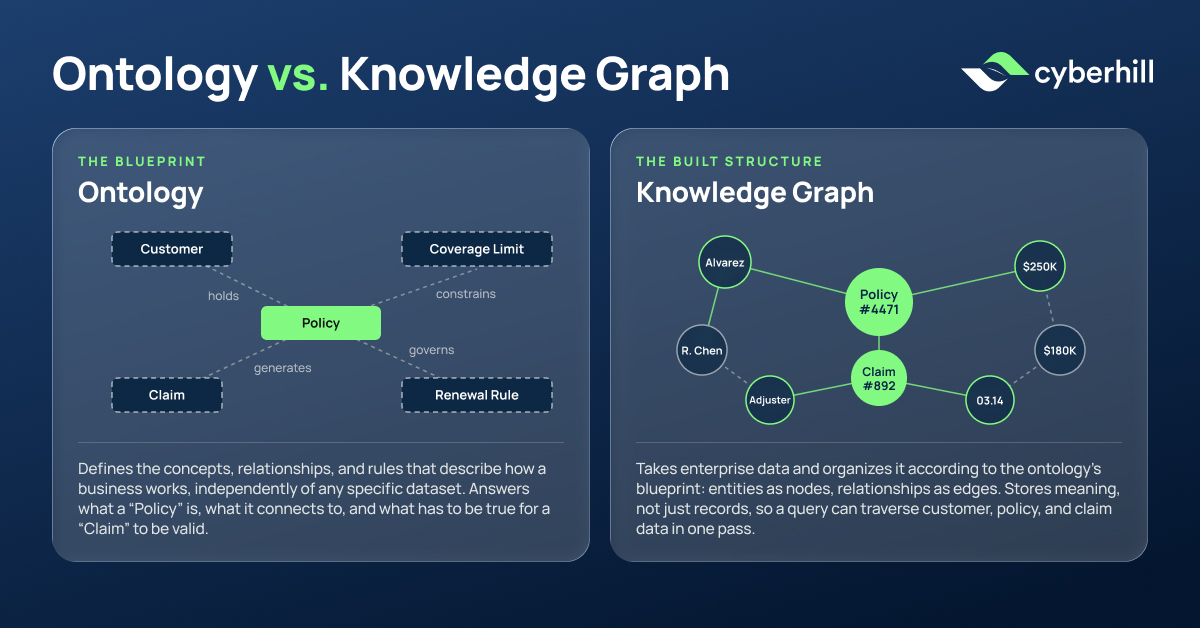
The two terms get used interchangeably, but they do different jobs.
Ontology: The Blueprint
An ontology defines the concepts that matter in your business (customers, claims, contracts, incidents), the relationships between them, and the rules that govern how they connect. It answers questions like: What is a "policy"? What can a policy be connected to? What has to be true for a claim to be valid? It's a formal representation of how your business thinks, independent of any specific dataset.
Knowledge Graph: The Built Structure
A knowledge graph takes your actual data and organizes it according to that blueprint. Entities become nodes, relationships become edges. Where a traditional database stores records in isolated tables, a knowledge graph stores meaning: it can tell you not just that a customer and a claim both exist, but how they're connected and why that connection is relevant to the question being asked.
How They Work As A Pair
Consider an insurance enterprise. A policy ontology defines what a "policy" is, how it relates to a claim, a customer, and a coverage limit, and what rules govern renewal eligibility. The knowledge graph then connects the actual policy, claim, and customer records according to that definition, so a query about high-risk policies nearing renewal can traverse all three in a single pass instead of requiring a custom join across three separate systems.
An ontology without a knowledge graph is a plan with nothing built. A knowledge graph without an ontology is a structure with no shared definition of what anything means, which is the exact fragmentation problem enterprise AI runs into. Deployed together, they give AI systems something relational databases and data lakes can't: a semantic layer that supports reasoning, not just retrieval.
The Semantic Infrastructure Stack Behind Ontology-Driven AI
Getting from raw data to trustworthy AI output involves a specific technical stack. It's worth naming the pieces, because they show up in vendor evaluations, technical audits, and compliance reviews alike.
- RDF (Resource Description Framework): The data model that represents information as subject-predicate-object statements, the basic unit a knowledge graph is built from. Every fact in the graph (a customer holds a policy, a policy has a coverage limit) is expressed this way.
- OWL (Web Ontology Language): The language that formalizes the ontology itself, defining classes, properties, and logical rules. OWL is what lets a system infer new relationships from existing ones rather than only storing what's explicitly entered.
- SPARQL: The query language that lets both humans and AI systems ask questions across the graph and get answers grounded in governed data rather than a model's best guess.
Why This Stack Matters for AI Grounding
When an LLM is connected to this layer, every output can be traced back to its source data, the relationships that produced it, and the logic that governed the inference. That traceability is what separates production-grade enterprise AI, the kind that can pass an audit or explain a decision to a regulator, from a demo that happens to sound convincing.
Why Fragmented Data Breaks Enterprise AI
Enterprise leaders are facing a familiar but intensifying problem: as data volumes grow, so does the difficulty of making sense of it. AI gets positioned as the fix, but most AI systems struggle with the same basic requirement that makes enterprise decision-making hard in the first place: context.
The Silo Problem
Data fragmentation shows up in a few predictable ways:
- The same term means different things in different systems (a "customer" in sales isn't necessarily a "customer" in billing)
- Business logic lives in tribal knowledge, spreadsheets, and the heads of a handful of long-tenured employees rather than anywhere a system can read it
- Departments label and structure similar data inconsistently, so what looks like duplicate information is actually three different partial views of the same entity
Without a shared understanding of what terms mean, how systems relate, and what rules govern their behavior, AI models become brittle. They're prone to hallucination not because the underlying model is weak, but because nothing has told them what the data actually means.
Why More Data Doesn’t Solve This
This is the part that catches most enterprise AI initiatives off guard. Adding more data, more compute, or a more capable model doesn't fix a semantic problem. Even the most sophisticated machine learning system will deliver incomplete or incorrect answers if it's unaware of the meaning underneath the data it's processing. The fix isn't more scale. It's a shared semantic layer that resolves the fragmentation before the AI ever sees the data. That's the role ontologies and knowledge graphs play: not an academic abstraction, but business-critical infrastructure for AI that can actually be trusted.
How Knowledge Graphs Improve LLM Accuracy
In benchmark studies conducted with data.world across 43 enterprise-grade questions and complex schemas, adding ontology-based query validation and repair to an LLM boosted accuracy by more than 4.2 times.
- Without ontology grounding: 17% execution accuracy, with the LLM frequently hallucinating SQL syntax or misinterpreting schema relationships
- With ontology-based query validation and repair: 72.6% execution accuracy
- Net improvement: 4.2x
Why The Improvement Is This Large
An ungrounded LLM answering a question about enterprise data is working from statistical inference. It's guessing at what a schema probably means based on patterns from its training data, not what your schema actually means. An ontology-backed knowledge graph removes the guesswork. The model queries against a structure that already encodes the correct relationships, constraints, and business rules, so it's retrieving grounded answers instead of generating plausible-sounding ones.
What This Looks Like In Production
Beyond the benchmark, this translates to measurable outcomes for enterprises deploying the approach in production: time-to-answer reduced by more than 50%, data integration speeds improved by 60 to 70%, and accuracy of AI-assisted queries increased by more than 300%.
For businesses operationalizing AI through virtual assistants, analytics automation, or compliance reporting, these aren't incremental gains. They're the difference between a pilot that stalls and a system a business is willing to put in front of a regulator.
Closing the Trust Gap in Regulated Industries
Cyberhill serves clients operating in environments where accuracy, explainability, and control aren't optional. Finance, healthcare, government, and energy organizations don't need a flashy AI demo. They need systems that deliver consistent, explainable output grounded in real, governed data, because the alternative is an audit finding, a compliance violation, or a decision nobody can defend.
What Ontology-Backed AI Enables In These Environments
- Hallucination elimination in AI-driven applications, through rules-based LLM repair and semantic validation rather than post-hoc fact-checking
- Integration of siloed data, by mapping inconsistent schema elements (a "Customer" in one system, a "Client" in another) into a shared, reusable semantic framework
- Faster discovery and analytics, through metadata-aware, semantically enriched catalogs that function like a search interface over the entire data estate
- Model output traceability, so every AI-generated answer can be traced back to its source data, its decision path, and the inference logic that produced it
Why Traceability is the Real Requirement
Regulated industries don't just need AI to be accurate. They need to be able to prove it was accurate, after the fact, to someone who wasn't in the room when the model produced the answer. Traceability is what makes that possible: it turns "the AI said so" into an auditable chain from source data to output. That's the difference between a compliance conversation that ends in five minutes and one that turns into a multi-week investigation.
How Cerebro Puts Ontology-First AI Into Practice
This is what the approach looks like end-to-end, and it's the mechanism behind how Cerebro operationalizes ontology-driven AI for enterprise clients.
1. Domain-Specific Ontology Workshop
Work begins by co-developing a semantic model tailored to the enterprise, whether the domain is insurance, energy, life sciences, or financial services. This step identifies the core entities, their attributes, and the business logic that governs them, in partnership with the people who actually understand how the business runs.
2. Data Ingestion and Harmonization
Data gets ingested and harmonized using graph-native tools, often accelerated by data.world's knowledge graph-based data catalog. The output is a knowledge graph that's SPARQL-queryable, RDF-compliant, and OWL-annotated, built to support both human and machine reasoning over the data.
3. AI-Layer Overlap
Once the knowledge graph is in place, AI capabilities get layered on top: LLMs guided and constrained by the ontology, with query checking and repair mechanisms built in so outputs stay grounded in the data rather than drifting into plausible-sounding fabrication.
4. Governance and Validation
The last layer is automated validation, version control, and human-in-the-loop workflows, so the system stays traceable, auditable, and maintainable as it scales rather than becoming another black box six months in.
This is the mechanism behind Cerebro: production AI deployed on enterprise data, grounded in semantic infrastructure the enterprise owns rather than infrastructure locked inside a vendor's black box.
See how Cerebro worksScaling From One Ontology to Enterprise-Wide AI
Organizations are increasingly recognizing that semantic infrastructure isn't a nice-to-have feature bolted onto an AI initiative. It's a prerequisite. Build AI on top of fragmented, ungoverned data, and you're building on sand. Build it on top of an ontology-backed knowledge graph, and you're building on a foundation that gets stronger as it scales.
Where Most Enterprises Start
The pattern is consistent: organizations begin with a single, targeted ontology tied to one high-value question. A common starting point is something like, "Which of our customers are at regulatory risk?" That scope is deliberately narrow. It's small enough to stand up quickly and prove value, but structured in a way that doesn't box the organization into a one-off project.
Why The Expansion Happens Naturally
Once that first ontology is in place and the AI built on top of it is producing trustworthy, explainable answers, the value of extending the same approach to adjacent domains becomes obvious internally. Finance sees what compliance did. Operations sees what finance did. The knowledge layer expands because the first deployment already proved the model works, not because a second, separate business case had to be built from scratch.
What This Means In Practice
- The transition from proof of concept to enterprise-wide infrastructure is evolutionary, not disruptive
- Each new domain reuses the same semantic backbone rather than starting over
- The AI layer gets more capable as the knowledge graph gets broader, because it's reasoning over an increasingly complete picture of the business
For organizations serious about aligning AI investment with business outcomes, this is the most important structural decision they'll make: start with infrastructure that's built to extend, not infrastructure that solves one problem and dead-ends.
Start With One High-Value Ontology Workshop
Enterprise AI doesn't fail because the models are weak. It fails because the systems underneath them don't share a common understanding of the business. Ontologies and knowledge graphs fix that at the source, and the data backs it up: a 4.2x improvement in query accuracy, a jump from 17% to 72.6% execution accuracy, and measurable reductions in time-to-answer once the semantic layer is in place.
Cerebro is how Cyberhill puts this into practice: production AI built on your enterprise data, grounded in ontologies and knowledge graphs your organization owns rather than infrastructure locked inside someone else's black box. The path in doesn't require boiling the ocean. It starts with one domain, one high-value question, and a workshop to define the semantic model that answers it.
Ready to see what this looks like for your data?
Book a Use Case SessionOntology-Backed Knowledge Graphs: FAQs
What Is the Difference Between an Ontology and a Knowledge Graph?
An ontology is the blueprint: it defines the concepts, relationships, and rules that describe how a business works, independent of any specific dataset. A knowledge graph is the built structure: it takes actual enterprise data and organizes it according to that blueprint, with entities as nodes and relationships as edges. An ontology without a knowledge graph is a plan with nothing built. A knowledge graph without an ontology has no shared definition of what its data actually means.
How Do Knowledge Graphs Improve LLM Accuracy?
An ungrounded LLM answers questions about enterprise data by statistically inferring what a schema probably means, based on patterns from training data rather than the schema itself. A knowledge graph removes that guesswork by giving the model a structure that already encodes the correct relationships, constraints, and business rules. In benchmark testing with data.world across 43 enterprise-grade questions, adding ontology-based query validation and repair improved execution accuracy from 17% to 72.6%, a 4.2x gain.
How Do Knowledge Graphs Reduce AI Hallucinations?
Hallucinations happen when a model fills in missing context with plausible-sounding inference instead of verified fact. A knowledge graph gives the model governed, relationship-structured data to query against, so outputs are retrieved from a source of truth rather than generated from pattern-matching. Paired with rules-based query validation and repair, this catches and corrects errors before they reach the output rather than requiring a human to fact-check after the fact.
What Is AI Model Output Traceability, and Why Does It Matter?
Traceability means every AI-generated answer can be traced back to its source data, the relationships that produced it, and the logic that governed the inference. Without it, an AI system's output is a black box: accurate or not, there's no way to prove which. In regulated industries like finance, healthcare, and energy, that provability is what turns "the AI said so" into an auditable chain a compliance team or regulator can actually follow.
How Do Ontologies Support Enterprise Data Integration?
Different departments often use different terms for the same underlying concept. A "Customer" in sales might be a "Client" in billing and an "Account" in support. An ontology resolves that by mapping inconsistent schema elements into a single, reusable semantic framework, so data from siloed systems can be integrated and queried consistently instead of requiring custom logic for every new connection.