
Why RAG Alone Isn't Enough for Enterprise AI
Large enterprises are racing to adopt AI, and most are starting the same place: Retrieval-Augmented Generation. RAG pairs a vector database with an orchestration layer and an enterprise-tuned LLM, and it works — it gets AI running fast, with real early wins.
But RAG was never built to carry an enterprise at full scale. It's a starting point, not a foundation.
Why RAG Isn't Enough for Enterprise AI at Scale
RAG earns trust quickly because it's fast to deploy and easy to point at a body of documents. That speed is also its ceiling. RAG retrieves, but it doesn't reason across relationships, enforce governance, or guarantee the same answer holds up under audit six months from now.
Security and compliance are the first things to break. RAG architectures are typically built to answer questions, not to prove how they arrived at an answer. This distinction matters the moment a regulator, auditor, or customer asks for a trail.
What Are RAG's Biggest Limitations for Large Organizations?
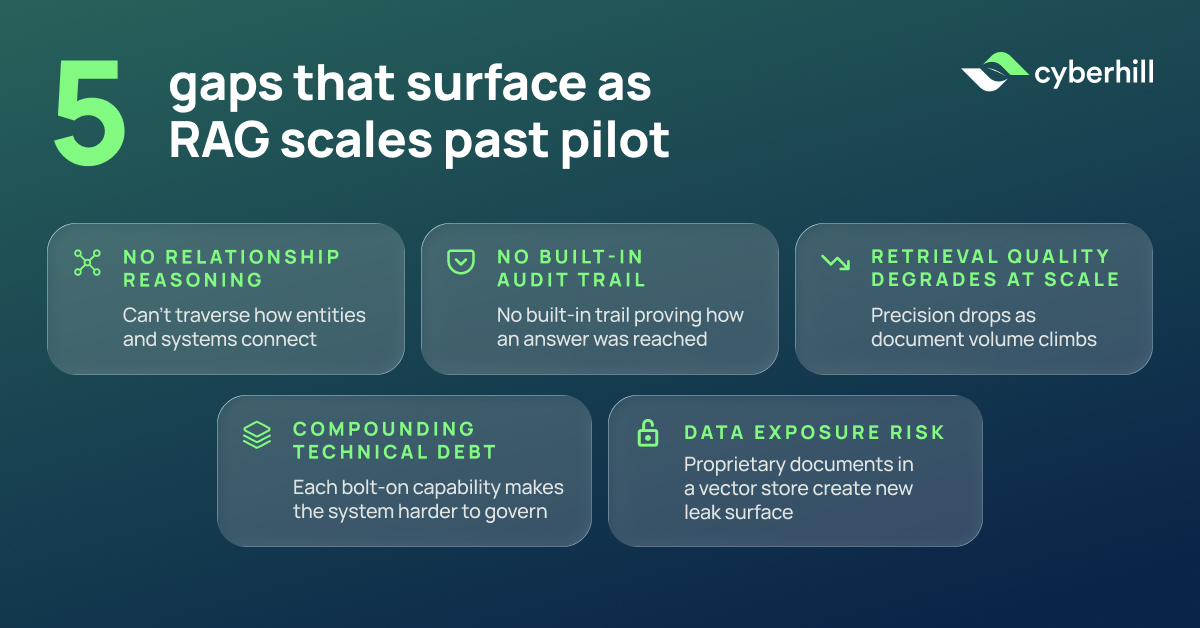
Five gaps show up consistently as RAG scales past a pilot:
- No relationship reasoning. RAG retrieves relevant text chunks by similarity, so it can't traverse how entities, systems, or policies connect.
- No built-in audit trail. Answers are generated, not proven. That's a hard limit for regulated industries where "the AI said so" isn't an acceptable answer.
- Retrieval quality degrades at scale. The more documents you index, the harder it gets to surface the right chunk: precision drops as volume climbs, right when the stakes get higher.
- Compounding technical debt. More capabilities can be bolted onto RAG over time, but each addition makes the system harder to govern, not easier.
- Data exposure risk. Pulling proprietary documents into a vector store creates a new surface for sensitive data to leak or be retrieved out of context.
RAG vs. an Ontology-Driven Approach
RAG and ontology-driven architecture solve different problems. RAG retrieves relevant information. An ontology structures what that information means — how entities, systems, and rules relate to one another — so an AI system can reason across those relationships instead of just surfacing a matching document.
That distinction is the difference between an AI system that answers questions and one that can be trusted to act on them.
Palantir is the clearest example of this at commercial scale: security, traceability, and ontology are the architecture. That's the model Enterprise AI has to follow, not RAG.
What Is "Enterprise AI," and How Is It Different from a RAG Deployment?
Enterprise AI, as we use the term, is a holistic implementation approach: built from the start to handle scale, compliance, security, and governance rather than a pilot that gets hardened after the fact. It assumes multi-stakeholder environments, regulated industries, and global operations from day one, so the systems an organization deploys today don't become liabilities tomorrow.
RAG can be part of that architecture. It cannot be that architecture on its own.
What Happens When You Scale RAG Without a Governance Foundation?
History has a pattern here. Enterprises that raced to adopt early-stage technologies without asking the hard questions upfront often paid for it later — with expensive, disruptive transitions once compliance, security, or model sustainment caught up with them.
RAG is following the same trajectory. It's easy to stand up and easy to expand, which is exactly why it's easy to scale past the point where it can be governed. Getting ahead as an organization means planning for an ontology-driven foundation before scale forces the issue.
What Questions Should You Ask Before Committing to a RAG-Only Strategy?
Before expanding a RAG deployment past pilot, it's worth answering four questions directly:
- 1.Can this system prove how it reached an answer, not just produce one?
- 2.Does it hold up under audit six months from now, not just today?
- 3.Can it reason across relationships between systems, or only retrieve documents?
- 4.What does it cost to govern this at 10x the current scale?
If any of those don't have a confident answer, that's the signal to start planning the foundation now — rather than after the expansion.
The Path Forward: From RAG to Enterprise AI
AI adoption isn't about winning this quarter. RAG can get you moving, but it can't carry the weight of your enterprise on its own. For organizations serious about scale, security, and long-term governance, the path forward runs through an ontology-driven foundation — not another layer bolted onto RAG.
If you're ready to talk through what that foundation looks like for your organization, talk to our team.
See how an ontology-driven foundation would work for your specific environment and use case.
Talk to Our TeamRAG Limitations and Enterprise AI: FAQs
What is RAG in enterprise AI?
Retrieval-Augmented Generation (RAG) is an architecture that pairs a large language model with a retrieval system (typically a vector database) so the model can pull relevant information from an organization's own data before generating a response.
Is RAG the same as enterprise AI?
No. RAG is one component that can support an enterprise AI deployment, but it's not a complete architecture on its own. Enterprise AI requires governance, security, and reasoning capabilities that RAG alone doesn't provide.
Can RAG be secure enough for regulated industries?
RAG can be configured with access controls and data protections, but the architecture itself doesn't produce an audit trail proving how it reached an answer — an important requirement in most regulated environments. That gap needs to be closed at the architecture level, not patched after deployment.
What's the difference between RAG and knowledge graphs?
RAG retrieves information based on similarity. Knowledge graphs structure entities and their relationships, enabling reasoning across connections that RAG can't traverse on its own.
Why do ontologies matter for enterprise AI?
An ontology defines what an organization's data actually means — how systems, entities, and rules relate to each other — giving an AI system the structure it needs to reason reliably, not just retrieve.
Is GraphRAG the same as an ontology-driven architecture?
No. GraphRAG layers graph structure onto a retrieval pipeline. It helps RAG better traverse relationships, but the underlying system is still organized around retrieval. An ontology-driven architecture starts from the opposite direction: the data model is defined first, and retrieval, reasoning, and governance are all built on top of that shared structure. GraphRAG is an improvement to RAG. It isn't a substitute for an ontology.
How does Cyberhill's approach differ from Palantir's?
Both treat ontology as foundational, not optional. The difference is in cost, lock-in, and ownership. Palantir's Foundry and AIP are proven, capable systems, but they come as a closed commitment: the ontology lives inside Palantir's environment, on Palantir's terms. Cyberhill builds the ontology as something the organization actually owns — with a clearer cost structure and no dependency on staying inside one vendor's ecosystem. For the full breakdown, see Palantir AIP vs. Cerebro: Cost, Lock-In, and Who Actually Owns Your AI.