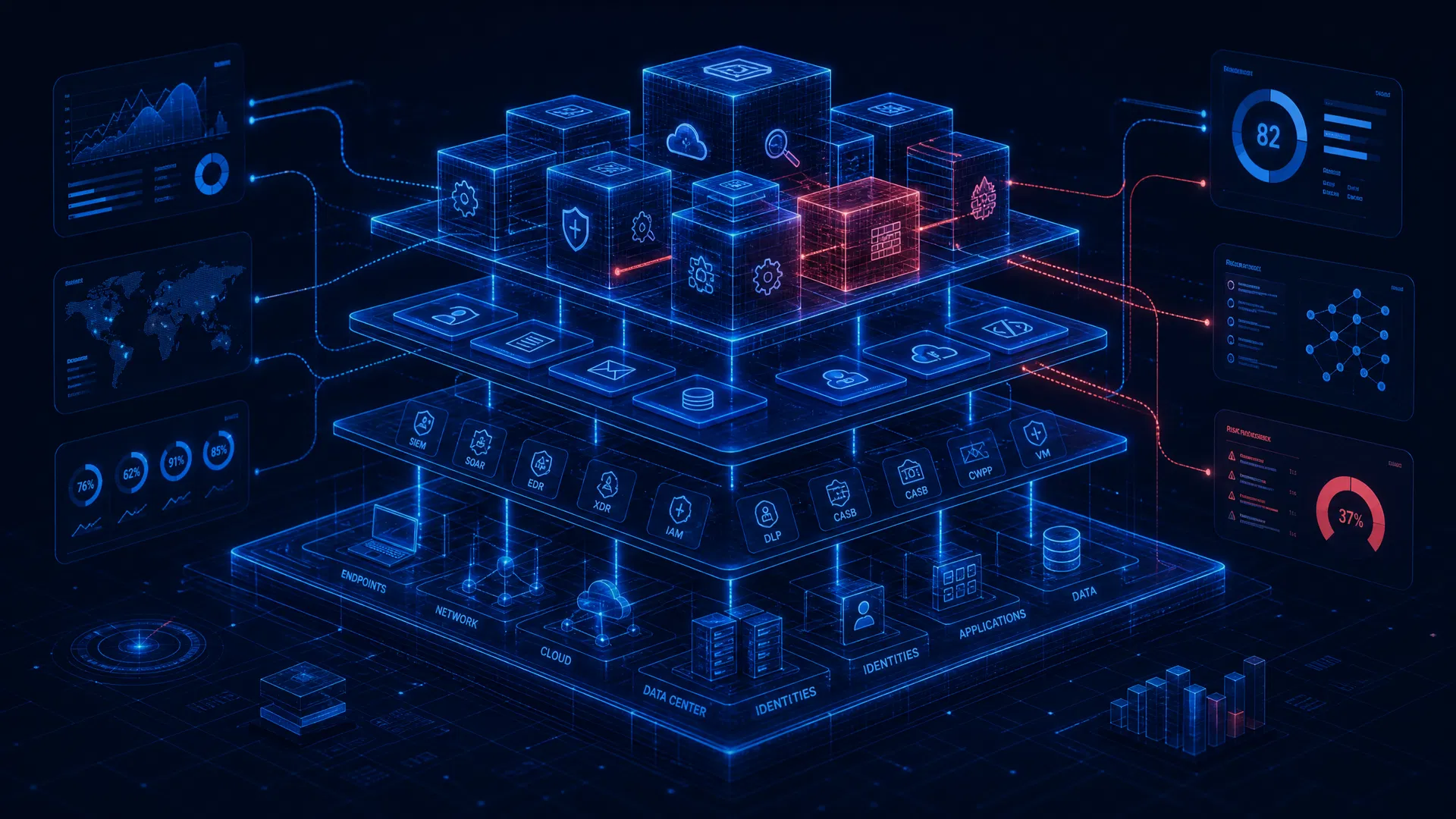
Ask a CISO what’s running in their security stack, and they’ll hand you a list. Firewalls, EDR, IAM, SIEM, a dozen point solutions bought over the years for a dozen different reasons. That list is usually accurate, but it isn’t entirely complete.
A tool list tells you what you bought. It doesn't tell you what's covered, what's overlapping, or what quietly stopped mattering the day a team migrated to a new cloud provider.
That gap between what you own and what you know is where risk lives. Enterprise security stacks change constantly through new tools, M&A, shadow IT, and vendor churn. Every one of those changes makes yesterday's inventory a little less true. Most organizations don't notice until an audit, a breach, or a board meeting forces the question: what exactly are we running, and is it doing what we think it's doing?
That’s a velocity problem rather than a knowledge one. And it’s solvable once you stop treating your inventory as a document and start treating it as a living system.
What an Accurate Security Stack Inventory Means
Most security teams have a version of an inventory. It’s that spreadsheet that lists all of your company’s vendor contracts, or the CMDB entries created when a tool was first deployed. That’s a solid starting point, but not a whole answer.
An accurate inventory does three things that a tool list doesn’t:
- Maps coverage, not just ownership. It shows what each tool actually protects, not just that it was purchased.
- Surfaces overlap. Two tools covering the same risk isn't redundancy by design; it's spend without a plan.
- Flags what's unaccounted for. The assets, accounts, and services nobody remembered to add.
This is the distinction that matters for the rest of this piece. Knowing your vendors is procurement. Knowing your coverage is security. Most enterprises have built the first and assumed it covers the second.
Why Your Inventory Starts Going Stale the Day You Finish It
An inventory is less like a single snapshot and more like a moving target. Here’s what keeps that target moving:
- Shadow IT. A team spins up a SaaS tool with a credit card and never tells security. It's now touching company data, and it's invisible to whatever list you maintain.
- M&A. Every acquisition brings an entire tech stack with it, one nobody on your team built, documented, or fully understands. Integration timelines rarely include a full audit before those systems start talking to yours.
- Personnel-driven tool adoption. A new security hire arrives with a strong opinion about a vendor they used at their last job. They deploy it because it's familiar, not because anyone assessed whether it duplicates something already in place.
- Cloud and SaaS sprawl. Spinning up a new instance or subscribing to a new service takes minutes and rarely routes through the same procurement process as a hardware purchase. Growth happens faster than documentation.
Any one of these can happen without a formal purchase order, a security review, or a line in a CMDB. Multiply that across a mid-to-large enterprise, and the gap between what's documented and what's actually running compounds by the week, not the year.
Why Spreadsheets, CMDBs, & Annual Audits Can't Keep Pace
The tools most enterprises rely on to track their stack weren't built for continuous change. They were built to record a moment in time and then wait for someone to update them.
A spreadsheet only knows what a human remembers to type into it. There's no trigger that fires when a new SaaS subscription goes live, or a contractor's account gets provisioned. The update depends entirely on someone in the loop deciding it's worth logging, on a day when they're already busy doing something else.
A CMDB has the same structural weakness, just with better formatting. It's populated when a tool is first deployed and rarely touched again unless a process specifically requires it. Most CMDBs drift from reality within months, not because anyone is negligent, but because nothing in the system forces a correction.
Annual or quarterly audits don't fix this; they just formalize the lag. An audit gives you an accurate picture of your stack as of the day it was conducted. By the time the report is finalized, reviewed, and distributed, weeks have usually passed, and the stack has already changed underneath it. You're making decisions off a photograph in a world that moves like video.
The result is a gap between what's documented and what's real that never fully closes. It only resets, briefly, each time someone does the work manually, before starting to widen again.
What an Outdated Inventory Costs Your Business
Inventory gaps shroud up as real, quantifiable cost in four places.
1. Redundant Spend
Two tools covering the same function mean paying twice for one outcome. Multiply that across a stack with dozens of point solutions accumulated over years, and the waste compounds quietly, buried in renewal invoices nobody re-evaluates.
2. Coverage Gaps
The inverse problem is just as costly. If nobody can confirm what's actually protected, something is almost certainly unprotected. Attackers don't need to find a sophisticated vulnerability if they can find an asset that was never inventoried in the first place.
3. Audit & Compliance Exposure
Regulators and auditors expect a defensible answer to "What do you have, and how is it secured?" An inventory that's months out of date, or one built from a spreadsheet nobody's touched since the last audit cycle, doesn't hold up under scrutiny. That exposure lands squarely on the CISO's desk.
4. Boardroom Credibility
This is the cost that's hardest to put a number on but the easiest to feel. Walking into a board meeting without a current, defensible view of the stack makes every security spend request harder to justify. It's difficult to argue for a bigger budget, or defend the one you have, when you can't say with confidence what you're already paying for.
These costs are direct, measurable consequences of treating an inventory as something you build once instead of something you maintain continuously.
From Static List to Living Map: What CAASM Changes
The category built to solve this is called Cyber Asset Attack Surface Management, or CAASM. It's worth understanding on its own terms, not just as a fix for the problems already covered.
How CAASM Actually Works
CAASM doesn't ask anyone to manually log an asset. Instead, it:
- Pulls data directly from tools you already run — identity provider, endpoint management, cloud consoles, security tools
- Cross-references what each system reports to catch mismatches automatically
- Updates continuously, because the underlying systems changed, not because someone remembered to open a spreadsheet
If your EDR sees a device your IAM doesn't recognize, or your cloud console shows an instance no ticket ever documented, CAASM surfaces that mismatch on its own.
CAASM vs. CMDB
| CMDB | CAASM | |
|---|---|---|
| Data source | Manual entry, logged once at deployment | Pulled continuously from existing tools |
| Update trigger | Someone remembers to update it | Systems change, data refreshes automatically |
| Best at | Recording configuration history | Reconciling coverage in real time |
One depends on someone remembering to write something down. The other depends on the systems talking to each other.
CAASM vs. EASM
The two get conflated often enough that it's worth separating them directly:
- EASM (External Attack Surface Management) maps what's visible to an outside attacker: public domains, exposed APIs, internet-facing infrastructure
- CAASM maps everything, internal and external, whether or not it's exposed to the outside world
EASM tells you what an attacker could find. CAASM tells you what you actually have.
What a Living Inventory Shows You
Continuous data collection is the mechanism. But the output has to answer questions a CISO can actually act on, not just produce more data to sort through.
A living inventory should show you, at any moment:
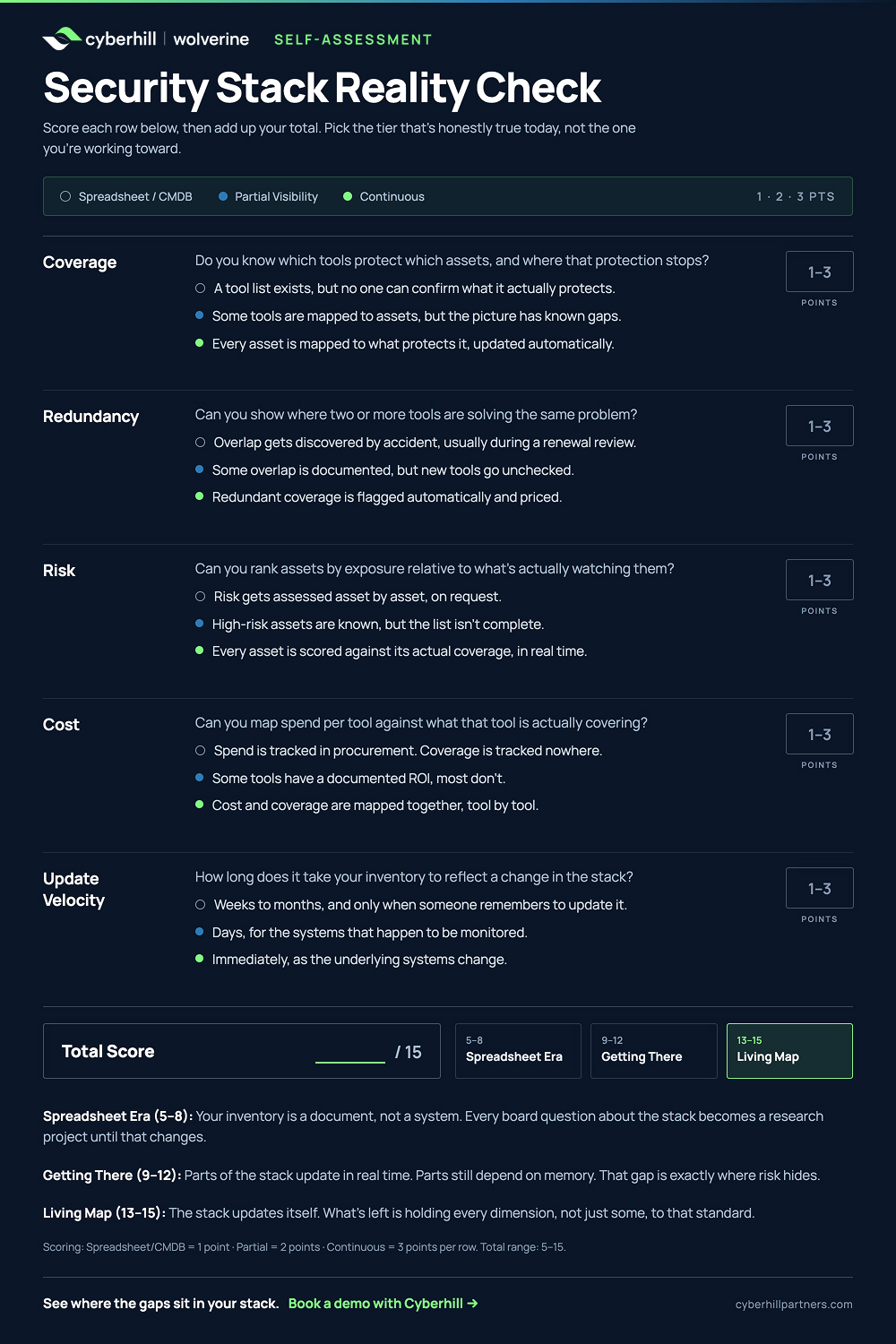
- Coverage: which tools are protecting which assets, and where that protection actually starts and stops
- Redundancy: where two or more tools are solving the same problem, and what that overlap is costing
- Risk: which assets carry the most exposure relative to what's actually watching them
- Cost: what you're spending per tool, mapped against what that tool is actually covering
This is the standard worth holding any solution to, including the one you already have. If your current setup can't answer all four in real time, it's not giving you a living inventory. It's giving you a nicer-looking spreadsheet.
This is the gap Wolverine, Cyberhill's AI-powered digital twin of the enterprise stack, is built to close. Rather than reconstructing coverage from a static record, it maintains a continuously updated model of the stack, cost, coverage, redundancy, and risk mapped together, so the answer to "what do we actually have" doesn't require a project every time someone asks it.
How Wolverine Closes the Gap
What makes Wolverine different from other monitoring tools is what it does with the connections between assets and not just the assets themselves:
- Dependency mapping. Wolverine not only confirms a tool exists, but also maps what that tool depends on and what depends on it. That's what turns "we have 40 security tools" into "here's what actually happens if we remove one."
- Scenario modeling. Because it's a live digital twin, you can test a change (retiring a redundant tool, consolidating vendors) before making it, instead of finding out the consequences after the fact.
- Board-ready reporting. Coverage, redundancy, and cost data translate directly into the language a non-technical board understands: what you're spending, what it's protecting, and what would happen if it went away.
- Deployment in weeks, not years. Unlike a full asset-management overhaul, Wolverine layers onto tools you already run rather than replacing them.
The result is a standing, current answer to “what is our stack actually doing for us,” available the moment someone- a CISO, an auditor, or a board member asks the question.
Turn Your Tool List Into a Coverage Map
Every enterprise already has a version of a security stack inventory. The question isn't whether one exists; it's whether it's still true.
Given how fast shadow IT, M&A, and cloud sprawl move, a static list has a shelf life measured in weeks. The fix isn't a better spreadsheet or a more thorough annual audit. It's moving to a model that updates as fast as the stack does.
If you can't currently answer coverage, redundancy, risk, and cost for your entire stack in real time, that's worth a conversation, not a project plan. Reach out to our team to see how Wolverine can turn your business’s tool list into a living map.
Cybersecurity Stack Inventory: FAQs
How Often Should You Reassess Your Security Stack Inventory?
With a continuous model like CAASM, the honest answer is that you shouldn't be "reassessing" on a schedule at all; the inventory updates as your stack changes. If you're still working from a spreadsheet or an annual audit, a quarterly refresh is the minimum to keep pace with normal tool churn, and any M&A, major cloud migration, or reorg should trigger an off-cycle review immediately.
What's the First Step If You're Starting From a Spreadsheet Today?
Don't try to manually rebuild a perfect list first. Start by connecting your existing tools, identity provider, endpoint management, and cloud consoles to a system that can cross-reference what each one already reports. The mismatches that surface in that first pass will tell you more than months of manual reconciliation would.
Does Adopting CAASM Mean Replacing Your Existing Security Tools?
No. CAASM layers on top of the tools you already run and pulls data from them; it doesn't require ripping anything out. The goal is reconciling what your existing tools already know, not adding another point solution to the pile.
Who Should Own the Security Stack Inventory: Security or IT?
In practice, both need to be in the loop, but security should own accountability for it. IT often has visibility into infrastructure and deployments that security doesn't see directly, while security owns the risk and compliance consequences when the inventory is wrong. A continuous system that pulls from both sides removes the ownership ambiguity by making the data shared instead of siloed.
How Does Continuous Visibility Affect Compliance Audits Like SOC 2 or ISO 27001?
Auditors are increasingly asking not just for an asset list, but for evidence of how current it is. A continuously updated inventory gives you a defensible, timestamped answer instead of a document someone updated before the last audit cycle. That shifts the audit conversation from "here's what we think we have" to "here's what the system confirms, as of right now."