Most enterprises frame their AI strategy as a binary choice: build a custom solution in-house or buy a vendor platform. That framing skips a third path that avoids the worst tradeoffs of both. You can deploy AI directly onto the infrastructure you already run, without a multi-year build and without handing your architecture to a vendor.
This matters because the path an enterprise chooses shapes far more than initial cost. It determines how much control you keep over your data and logic, how fast you reach production, and how easily you can change direction later without starting over.
What Are The Three Paths to Enterprise AI Deployment?
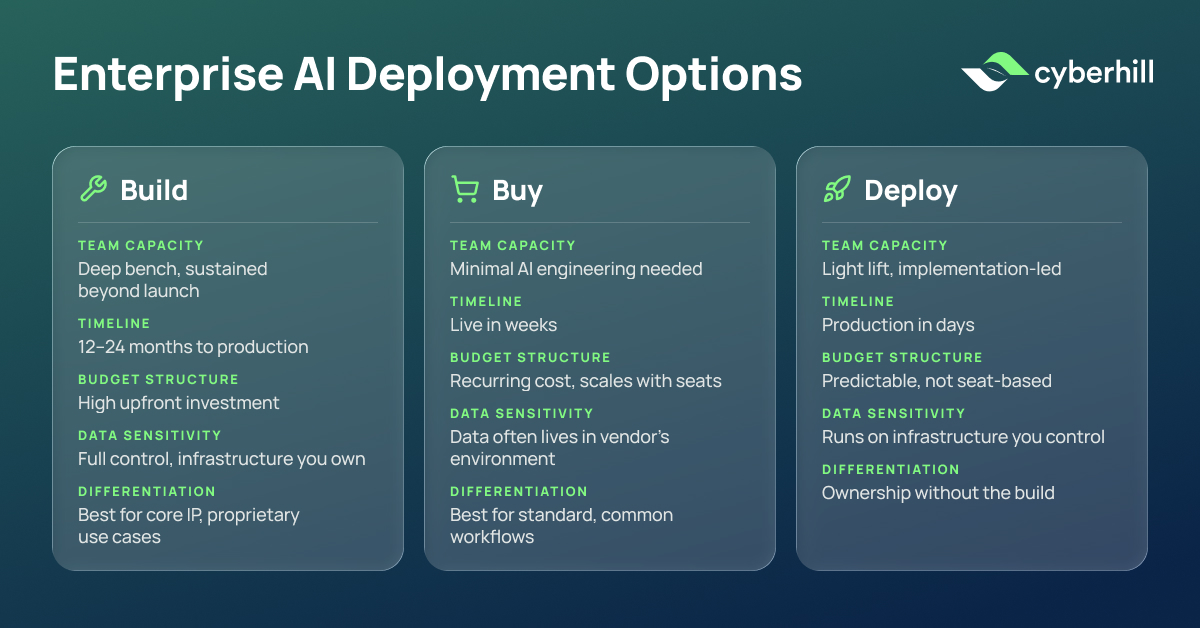
- Build means your team designs, trains, and maintains the AI capability from scratch, using internal engineering resources and infrastructure you control end to end, with staff trained and certified on an ongoing basis as the technology evolves.
- Buy means licensing a commercial AI platform from a vendor, typically priced per seat, where the underlying architecture and much of the AI logic live inside that vendor's proprietary environment.
- Deploy means implementing an AI solution directly on your existing tech stack, combining much of the speed of buying with the ownership and flexibility of building.
Each path solves for a different constraint. The right one depends on what your organization actually needs to protect: time, budget, or control.
Building In-House: What It Actually Costs
Building gives you the most control over your AI architecture. You own the code, the data pipeline, and the roadmap. For organizations with deep AI engineering talent and a use case that's genuinely core to competitive differentiation, that control can be worth the investment.
The costs are real, though, and they extend well past the initial budget line:
- Specialized AI talent is scarce and expensive to retain, and average tenure in AI-specific roles tends to run short, creating ongoing hiring and knowledge-transfer risk
- Internal builds are exposed to scope creep, since there's no external accountability forcing the project toward a shipped product
- Data quality and integration work routinely consumes far more time than model development itself
- Maintenance doesn't end at launch. Model drift, infrastructure upkeep, and compliance requirements are ongoing costs that don't show up in a project budget
Building tends to make sense when the AI capability is inseparable from your core product or competitive advantage, and when you have the sustained engineering bandwidth to support it long after the initial build. For most operational use cases, that bar isn't met.
Buying a Platform: The Trade-Offs Behind the Speed
Buying gets an enterprise to production faster than building. A vendor platform arrives with the infrastructure, security, and maintenance already handled, and enterprises can often go live within weeks rather than months.
That speed comes with trade-offs that tend to surface later rather than upfront:
- Per-seat pricing that looks manageable in a sales conversation often compounds significantly as usage scales across the organization
- The AI logic, ontology, and workflows you build inside the platform are licensed, not owned. If you leave, that structured intelligence layer stays behind
- Your organization becomes dependent on the vendor's roadmap, update cycle, and pricing decisions going forward
This is the core of the vendor lock-in problem, and it's the trade-off at the heart of large platform ecosystems like Palantir AIP. IP built on top of a licensed platform is licensed IP. For a deeper breakdown of what that means in practice, see our comparison of Cerebro and Palantir AIP.
Buying makes the most sense when the use case is standard rather than proprietary and speed matters more than long-term architectural control.
Deploying on Your Existing Stack: The Overlooked Third Option
Deployment sits apart from both build and buy. Rather than starting from zero or adopting a vendor's closed ecosystem, this path implements AI directly on the infrastructure, data, and systems an enterprise already runs.
Cerebro, the Runtime AI Fabric, is built around this approach. It's ontology-driven, meaning it structures your organization's data into a model your teams and AI systems can both use, and it deploys on your existing stack rather than requiring a rebuild or a new environment to manage. Because it's substantially pre-built and implemented by Cyberhill's AI engineering team, most organizations reach their first production use case in 14 days on their existing infrastructure, rather than the year or more a from-scratch build requires or the multi-year commitment a large platform vendor often assumes.
The architecture is also model-agnostic, so an enterprise isn't locked into a single AI provider the way they would be with a closed vendor ecosystem. As models change, the underlying deployment doesn't need to be rebuilt around a new vendor relationship.
This path directly addresses the two biggest risks in the build-or-buy framing: the time and talent cost of building, and the architectural lock-in of buying.
Get the speed of buying with the ownership of building.
Book a Use Case SessionHow to Choose the Right Path for Your Organization
There's no universal answer, but the decision becomes clearer once it's tied to a few concrete variables:
- Team capacity. Do you have sustained AI engineering bandwidth beyond the initial build, or is this a stretch for your current team?
- Timeline. Can the business wait 12 to 24 months for a build to reach production parity, or does the use case need to be live in weeks?
- Budget structure. Is your organization better positioned for upfront investment or predictable ongoing cost, and have you accounted for how per-seat pricing scales over time?
- Data sensitivity. Does the use case involve regulated or highly sensitive data that requires deployment on infrastructure you control?
- Strategic differentiation. Is this AI capability core to what makes your business competitive, or is it a standard operational workflow?
Organizations with a highly specialized, IP-core use case and deep engineering resources tend toward building. Organizations that need a standard capability fast, with less concern about long-term architectural control, tend toward buying. Organizations that want the speed of buying without giving up ownership of their data and logic are the ones deployment is built for.
What to Evaluate in a Deployment Partner
Deployment is the least familiar of the three paths, and "deploys on your existing stack" can mean very different things depending on the vendor. A few questions separate a genuine deployment approach from a platform sale with different marketing:
- 1.Does it deploy on your infrastructure, or just connect to it? Some solutions marketed as deployment still route data through the vendor's cloud environment or require your systems to conform to their architecture. A genuine deployment runs on infrastructure you already control, not alongside a new environment you now also have to manage.
- 2.Is the architecture actually model-agnostic? If a deployment locks you into a single underlying AI model, you've inherited the same dependency risk as buying a platform, just with different branding. Ask whether the model layer can change without rebuilding the deployment around it.
- 3.Who owns the ontology and logic once it's built? This is the question that matters most, and the one vendors are least likely to volunteer an answer to. If that structured intelligence (the object types, the workflows, the decision logic) lives in a format you control, it stays yours if the relationship ends. If it lives inside proprietary tooling, you're back to the lock-in problem deployment was supposed to solve.
- 4.How much is actually pre-built versus custom from scratch? A deployment that starts from zero on your infrastructure isn't meaningfully faster than building in-house. The speed advantage of deployment comes from a solution that's substantially pre-built and configured to your environment, not assembled from the ground up under a different name.
- 5.What does the implementation team look like? Deployment speed depends heavily on who's doing the implementing. A dedicated team with the right specialized roles (ontology engineers, AI security specialists, solution architects) tends to move faster and with fewer surprises than a generalist services team learning your environment as they go.
Getting clear answers to these questions before committing is what separates a deployment that actually delivers on the speed-and-ownership promise from one that quietly becomes a buy decision with extra steps.
Choosing a Path Without Locking In Your Future
The build vs. buy framing treats this as a one-time, permanent decision. It isn't. The right question isn't which path is universally best; it's which path fits your current constraints without creating dependencies you'll regret in two years.
Deployment exists precisely to remove that tradeoff: the speed of buying, the ownership of building, and the flexibility to change course as your AI maturity grows.
If you're weighing these paths for your own organization, book a Use Case Session with Cyberhill to walk through what deployment on your existing stack would actually look like.
Enterprise AI Deployment Options: Frequently Asked Questions
What are the deployment options for enterprise AI?
Enterprises generally choose between three paths: building a custom AI solution in-house, buying a vendor platform, or deploying an AI solution directly on their existing tech stack. Each involves different trade-offs in cost, speed, and control.
How long does each path typically take to reach production?
Building in-house commonly takes a year or more to reach production parity. Buying a vendor platform can go live in weeks but usually requires ongoing configuration as usage scales. Deployment on existing infrastructure, when substantially pre-built, can reach a first production use case in 14 days.
What's the difference between building, buying, and deploying enterprise AI?
Building means developing the AI capability entirely with internal resources. Buying means licensing a vendor's platform and working within its architecture. Deploying means implementing an AI solution on infrastructure your organization already owns and controls, without a full rebuild or a vendor's closed ecosystem.
What causes internal AI builds to stall or fail?
Common causes include underestimating data preparation time, talent attrition on specialized AI teams, scope creep without external accountability, and ongoing maintenance costs that weren't accounted for in the original project budget.
What are the hidden costs of buying an enterprise AI platform?
Per-seat pricing that scales significantly as usage grows across an organization, dependency on the vendor's product roadmap and pricing changes, and the fact that AI logic built inside the platform is licensed rather than owned.
Why do buy decisions often mean your AI logic lives in someone else's architecture?
Vendor platforms typically allow raw data export, but the structured intelligence built on top of that data, including ontologies, workflows, and decision logic, is usually built using the vendor's proprietary systems. That layer doesn't transfer if you leave the platform.
How should an enterprise decide which path fits their situation?
The decision should weigh internal engineering capacity, timeline pressure, budget structure, data sensitivity, and how core the AI use case is to competitive differentiation. Highly specialized, IP-core use cases with strong internal teams tend toward building. Standard use cases requiring speed tend toward buying. Organizations wanting both speed and ownership are best served by deployment on existing infrastructure.