Executive Summary
Workforce 360 is the reasoning layer for your workforce data.
It sits across the HR systems you already run and infers what they were never built to capture: real capability, informal influence, career trajectory, and flight risk. The result is a unified workforce intelligence layer, deployed in weeks, not months, fully explainable, and owned entirely by you.
Who This Is For
CHROs, VPs of People Analytics, Heads of Talent, Chief Data Officers, and any executive who makes decisions about people with incomplete information.
How It Works
Connect
Plug into your existing systems. HRIS, ATS, LMS, performance, compensation, benefits. No migration. No disruption.
Model
Build the ontology: a unified knowledge model of your entire workforce. Who you have, what they can do, where they sit, what they cost, how they connect.
Reason
Ask workforce questions in plain language. Get real answers in real time. No reports. No spreadsheets. Every answer shows its work.
Scale
Start with one use case. Prove the value. The ontology becomes your workforce intelligence foundation: an asset you own and grow.
What Your HR Systems Never Captured
Your HR systems know what someone typed into them. A title. A department. A short list of self-reported skills. A reporting line that says who sits above whom. That is the workforce as a set of fields, and for a long time it was the best any system could do.
The problem is that the fields leave out almost everything that matters. What a person is capable of, learned from the work they do rather than the box they checked. Who they really influence and unblock, which rarely matches the org chart. How their career has moved over time, and where it is heading next. None of this was ever entered, so none of it can be reported. When a key person resigns, when a role opens, when leadership proposes a reorg, the questions that follow are exactly the ones the record was never built to answer.
From System of Record to Reasoning Layer
A system of record stores what is known. It is a filing cabinet with a search box. Workforce 360 is built to do something different: reason over what the records imply but never stated. It reads the work people do, the way they collaborate, and the path their careers have taken, and it infers the layer beneath the fields.
That is the shift. Not a better dashboard on the same data, but a reasoning layer that sits across the systems you already run and surfaces what they could never hold on their own.
Breadth is what sets Workforce 360 apart. Most tools focus on one job: inferring skills, scoring flight risk, or mapping a network. Workforce 360 does it all in one place. The same layer that infers capability also maps influence, tracks how careers move, and ranks who is at risk of leaving and why. That breadth, reasoning across the whole picture instead of one slice of it, is what separates a reasoning layer from a point solution.
Some suites offer several of these as separate modules. The difference is that Workforce 360 reasons within a single connected model rather than stitching together outputs from tools that never share the same view of a person.
Start with Capability Inferred from Real Work
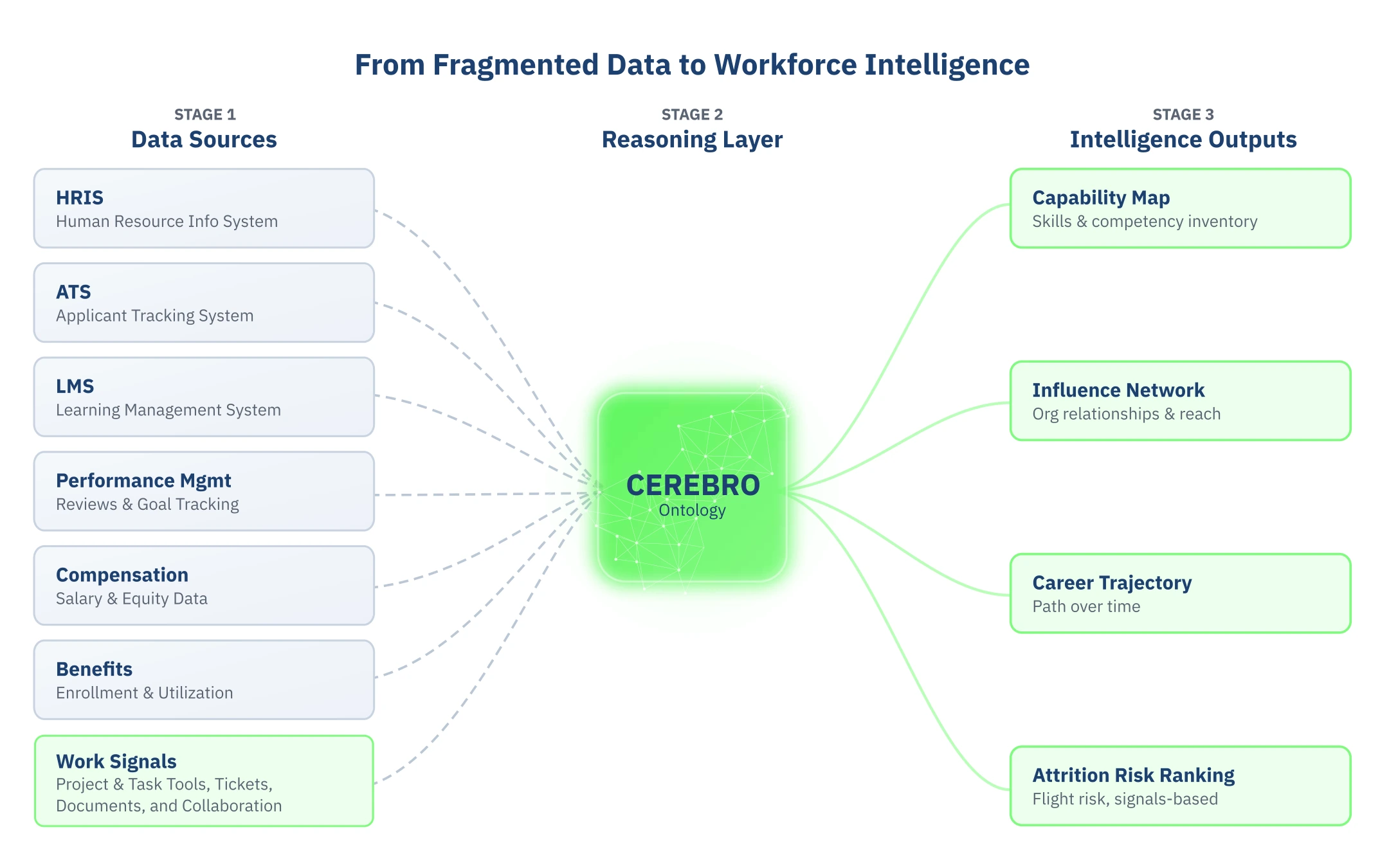
Capability inference is the clearest way to see the reasoning layer at work, so it is worth starting there. Most workforce tools are bounded by the skills data already entered. If no one built a skills inventory, there is nothing to analyze, and building one is a multi-year project most organizations never finish. Workforce 360 starts from the opposite end. It infers the skills layer from the work people do, so a client gets a capability view without first standing up a skills inventory.
It infers the skills layer from the work people do, so a client gets a capability view without first standing up a skills inventory.
Workforce 360 is designed to read from the systems where work already leaves a trace: project and task tools, tickets, documents, and the records already in your HR systems. It reads the shape of the work, what people are assigned, what they deliver, and what they contribute to, and infers capability from that. It works with the sources you already have, not with a new data-entry system.
Conventional tools require the answer as an input. Workforce 360 produces the capability layer where none exists, then keeps it current as the work changes. It is a concrete example of the larger pattern: reasoning past what the record holds. And it is only one of several reasoning capabilities the layer brings to bear.
What the Layer Sees That Records Can't
These are the three things Workforce 360 surfaces that your systems never captured. Each comes from reading the work itself rather than a field someone filled in. Capability is the first, and the two that follow build on the same idea.
Capability, Inferred from Real Work
A live view of what people can do, drawn from the tasks, projects, and contributions they are involved in, not from self-reported tags. Where skills data already exists, it is used as a signal, never a prerequisite. This is the capability layer produced where none was entered.
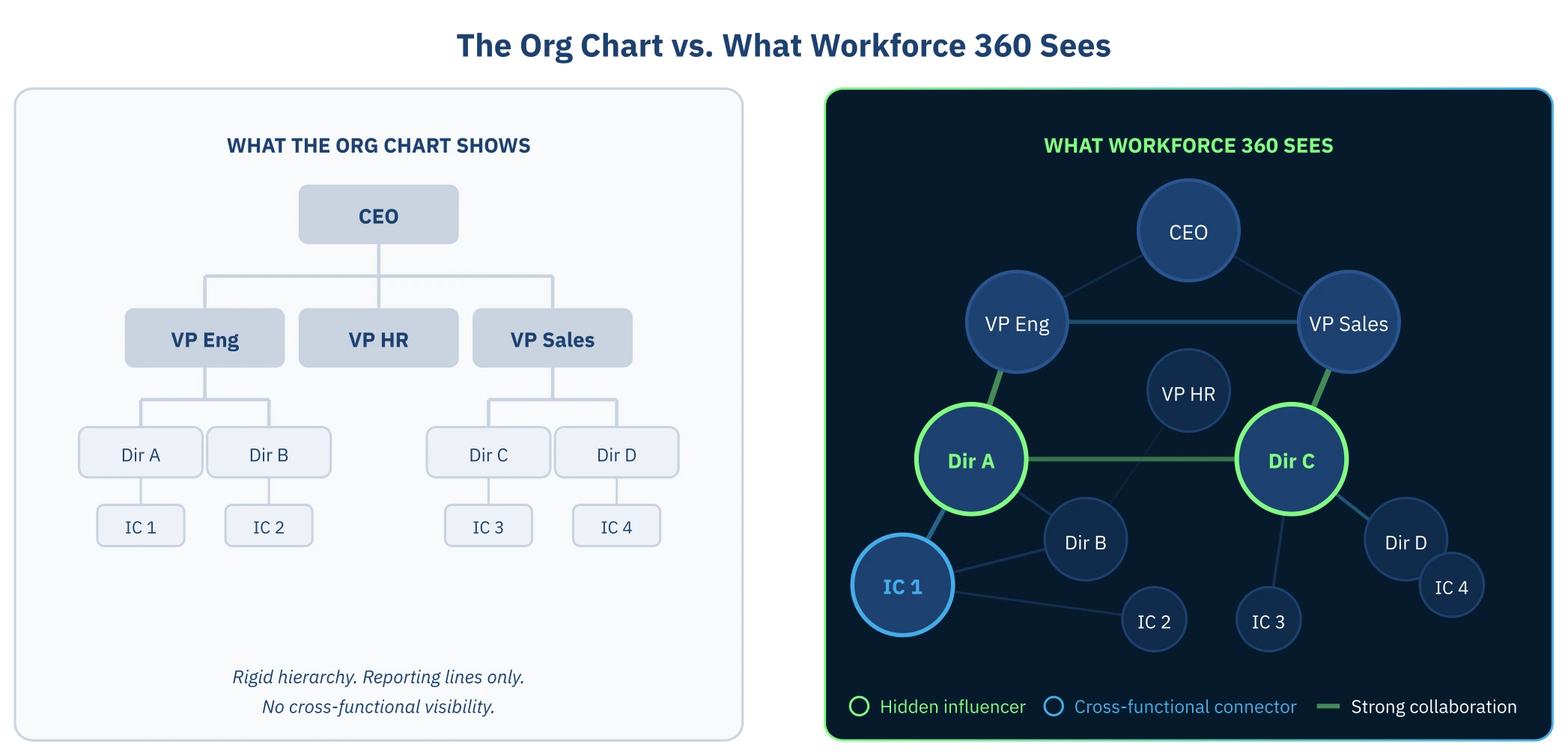
Influence and Dependency Beyond the Org Chart
A model of who works with whom, who mentors whom, and where informal influence really sits. The org chart shows the reporting line; this surfaces the dependencies that drive outcomes. It reads calendar and workflow signals, such as who works together and how often, never the content of anyone's messages. Consent is built in from the start, and anyone who opts out is excluded from the model.
Trajectory as a Continuous History
A person's path over time rather than a single current-state snapshot, so questions about learning velocity, readiness, and direction of change become answerable. Time and sequence are part of the model, which a state-snapshot system cannot express.
The Questions HR Can Finally Answer
These are the questions that cost the most and never get clean answers. The first one is the question most companies feel soonest: who is likely to leave. Workforce 360 answers it the way it answers everything, with a clear ranking you can see the reasons behind, not a black-box score you have to take on faith.
What Would a Proposed Reorg Break?
The informal dependencies and single points of coverage a restructuring would disrupt, surfaced before the change is finalized rather than discovered after.
Where Are the Skills Gaps?
The inferred capability base mapped against what current roles demand, so the gap is surfaced from the work itself rather than from a stale inventory.
Who Can Step into a Critical Role?
Successors ranked on capability inferred from work done, surfacing ready people a nomination-based plan never listed.
Which Internal Person Fits an Open Role?
Internal candidates matched to what a role actually requires, based on capability they have shown in real work, so you can look inside before hiring externally.
Who Is at Risk of Leaving?
A ranking across the workforce that shows the reasons behind each score instead of hiding them. It works today on the signals already in reach, and gets sharper as the influence and trajectory models mature and add more of the picture.
You do not have to wait for value. Several of these answers work today on data you already have, and the rest keep getting stronger as the influence and trajectory models add more of the picture over time.
Workforce 360 in Practice
Scenario A: Readiness for a New Initiative
Example dialogue. Figures are illustrative.
The Situation: The COO wants to stand up a new AI and automation program. Before greenlighting headcount requests, she needs to know whether the talent already exists inside the organization. Under normal circumstances, this question triggers weeks of manual skills audits and manager surveys. With Workforce 360, the answer is immediate.
COO
Do we have the data engineering talent internally to stand up the new AI program, or do we need to hire?
WORKFORCE 360
Based on inferred capability from project history and deliverables, 43 people across three business units are actively performing data engineering work. 12 of them have also contributed to ML pipeline projects in the last 6 months.
COO
How does that compare to what the program needs?
WORKFORCE 360
The program requires approximately 20 data engineers at various levels. You have sufficient senior capacity but a gap of 6–8 mid-level engineers. Internal mobility could fill 3 of those from adjacent roles showing upward trajectory in this domain.
COO
Who are the strongest internal candidates to lead it?
WORKFORCE 360
Three people rank highest on a combination of inferred capability, cross-functional influence, and leadership trajectory — with evidence behind each.
What This Demonstrates
The COO gets a capability answer drawn from actual work, not self-reported skills tags. She sees the gap quantified, internal mobility options surfaced, and leadership candidates ranked with explainable reasoning. No skills inventory prerequisite. No six-week audit.
Scenario B: Attrition Early Warning
Example dialogue. Figures are illustrative.
The Situation: The CHRO is preparing for the quarterly talent review and wants to get ahead of attrition before it becomes a crisis. Traditional flight risk models rely on tenure and compensation alone. Workforce 360 reads deeper signals.
CHRO
Who are we most at risk of losing in the next 90 days?
WORKFORCE 360
Here are your top 15 flight risks, ranked by confidence. Each ranking shows the contributing signals: declining collaboration frequency, stalled trajectory, compensation below market, or reduced cross-functional engagement.
CHRO
What's driving the risk for our top three?
WORKFORCE 360
Person 1: Trajectory has flatlined for 8 months despite high capability inference. Person 2: Collaboration network has narrowed by 40% in the last quarter, a pattern that often precedes voluntary exits. Person 3: Compensation sits 18% below market for their inferred skill level.
CHRO
What would it take to retain Person 1?
WORKFORCE 360
Compensation adjustment to market rate addresses the primary signal. A cross-functional project assignment would address trajectory stall. Both are actionable before the next review cycle.
What This Demonstrates
Flight risk that goes beyond tenure and comp. The reasoning layer reads trajectory, collaboration patterns, and market positioning together, then explains why each person is flagged. The CHRO gets actionable retention strategies, not a black-box score.
Breadth You Can Trust
People data requires more care, because these answers affect real careers and livelihoods. Workforce 360 is built on Cerebro, which is what makes this kind of analysis safe to use in HR. It reasons across the systems you already run, and every answer can be traced back to its source. That is what makes the breadth worth trusting: answers you can act on, and stand behind.
Every Inference Shows Its Work
Inferences are designed to carry a confidence level, so a weak signal reads as weak rather than passing as fact. Each one is explainable, with the evidence behind it in view, so it can inform, rather than automate, decisions about pay, promotion, or succession. The reasoning informs judgment, with a human in the loop, not the other way around.
Fair by Design
Rankings are designed to be tested for disparate impact across groups, and because the reasoning behind each one is open, it can be checked rather than trusted blindly. Rankings inform a person's decision; they do not make it, so human judgment and your own compliance review stay in the loop wherever inferences touch decisions about people.
Works with What You Already Have
Cerebro fits alongside your current systems. Nothing to rip out, nothing to migrate, no long data cleanup before you see anything useful.
Built to Respect People's Privacy
Influence and collaboration are read from patterns, never from the content of anyone's messages. Consent and clear governance are part of how it works, not an afterthought.
Secure, with a Track Record to Back It Up
Your data stays under your control, on a platform backed by more than seven years leading AI for the DoD and the U.S. government.
| Big 4 Consulting | AI Platforms | HR Analytics Tools | Workforce 360 | |
|---|---|---|---|---|
| Time to Value | 6–12 months | 3–6 months | Weeks (dashboards only) | Weeks |
| Cost | $500K–$2M per engagement | High + ongoing platform fees | Moderate (SaaS) | Predictable, all-inclusive |
| Data Unification | Manual (consultants do it) | You build it yourself | Limited to one system | Managed by Cyberhill |
| Domain Expertise | Generic frameworks | None (you configure) | Surface-level reporting | Built-in (HR + AI) |
| You Own the IP | No (walks out the door) | No (locked to platform) | No (SaaS rental) | Yes (capitalizable asset) |
| Explainable AI | N/A (human consultants) | Black box | N/A (no AI layer) | Fully traceable |
| Ongoing Support | Engagement ends | You're on your own | Ticket-based support | Managed & continuously evolved |
The Workforce Was Always More Than the Fields
Everything that makes a workforce hard to lead lives in the space between the records. Workforce 360 is built to reason over that space, so the questions that once took days of manual work, or went unanswered entirely, can be surfaced, explained, and acted on. It is the reasoning layer your systems of record were never designed to be.
If you lead people strategy or people analytics and want to see what your own systems are missing, let's have a conversation.
References
- 1.Bernstein, B., Rosenberg, J., & Hannan, C. (2025). Getting the true measure of skills. MIT Sloan Management Review.
- 2.The Apache Software Foundation. (n.d.). What is Apache Atlas? https://atlas.apache.org/#/WhatsItAllAbout