An enterprise AI investment gets evaluated the same way any other capital request does: what it costs, when it pays back, and what happens if the organization does nothing. The requests that stall in review are usually missing one of those three answers. The underlying technology is rarely the issue.
This piece lays out the framework for supplying all three: the ROI math a CFO expects to see, what belongs in a full cost model, how the build-versus-buy decision affects time-to-value, and the objections worth answering before they're asked. The result is a business case built to hold up under a finance review, not one designed to sound persuasive in the room.
Why Enterprise AI ROI Is Harder to Prove Than Traditional Software ROI
A traditional software purchase has a clean before-and-after. You replace one tool with another, and the delta in cost, speed, or output is straightforward to isolate. Enterprise AI rarely offers that same clean comparison, for three reasons:
The benefits are diffuse. An AI system that makes a team modestly more productive doesn't generate one trackable transaction. It shows up in small increments across dozens of workflows, which makes it easy to sense qualitatively and hard to prove quantitatively.
The value is adoption-dependent. A CRM delivers roughly the same value whether ten people use it or a hundred. An AI system's return scales directly with how many people actually use it, how well, and how consistently. Two identical deployments can produce very different ROI purely based on rollout execution.
There's rarely a like-for-like alternative on the shelf. Unlike a feature comparison between two vendors, the real counterfactual is continuing to do things the old way. What that costs matters just as much to the case as the projected return. A business case that only models the upside of AI and ignores the cost of inaction is incomplete on both sides of the ledger.
This doesn’t mean enterprise AI ROI can't be proven, but it does require the proof to be built differently, starting with a baseline captured before deployment rather than reconstructed after the fact (more on that shortly).
The Core Formula: ROI, Payback Period, and NPV
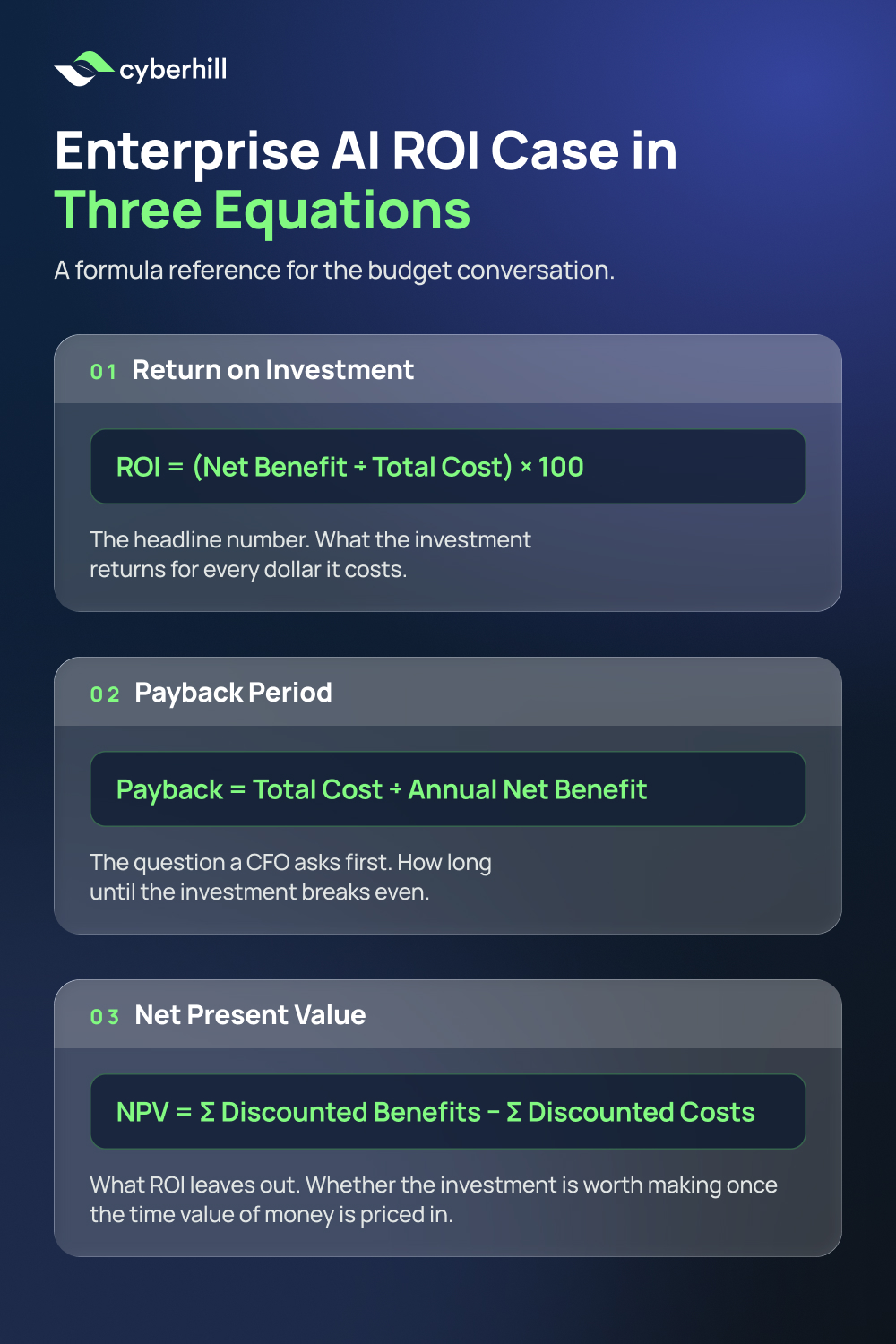
A CFO-ready case leads with numbers, not narrative. Three metrics do most of the work, and each answers a different question.
Return On Investment
Return on investment expresses total return as a percentage of total cost:
- ROI (%) = (Net Benefit ÷ Total Cost) × 100
This is the headline figure, easy to explain and easy to compare across competing initiatives, which is why it usually anchors the summary slide.
Payback Period
Payback period answers the question every CFO asks first: when do we get the money back?
- Payback Period = Total Cost ÷ Annual Net Benefit
Track cumulative net cash flow month by month rather than presenting a single blended figure. A project that breaks even at month fourteen tells a very different story than one that breaks even at month twenty-six, even if the three-year ROI looks similar on paper.
Net Present Value
Net present value accounts for what ROI alone leaves out: the time value of money.
- NPV = Sum of Discounted Net Benefits − Sum of Discounted Costs
NPV and payback period should be presented together. Payback speaks to urgency. NPV speaks to whether the investment is worth making at all once the discount rate is applied.
For larger, multi-year initiatives, internal rate of return and EBITDA impact are worth adding as well, since board-level reviews increasingly expect the investment to be framed in terms a finance committee can compare against other capital allocation options.
What Counts as Total Cost of Ownership?
The denominator in every one of these formulas is only as credible as the cost model behind it. A business case that only counts the license fee will overstate ROI and lose credibility the first time someone on the finance team asks a follow-up question. A full total cost of ownership model accounts for:
- Technology and infrastructure: platform fees, compute, integration work, and ongoing data pipeline maintenance
- Data readiness: the cleanup, structuring, and governance work most organizations underestimate going in
- Talent and implementation: internal time, external partners, and any specialized roles needed to build and maintain the system
- Change management: training, adoption support, and the temporary productivity dip that typically precedes the gain
- Ongoing operations: monitoring, maintenance, security, and compliance for the full life of the deployment
Skipping any one of these doesn't just understate cost. It's usually the specific gap a CFO catches first, and once one number in the model looks soft, the reviewer starts questioning all of them.
Establish the Baseline Before You Deploy Anything
The single most common reason a CFO rejects an AI ROI claim after the fact isn't a bad model. It's a missing baseline. Without a documented picture of what the process cost, how long it took, and how often it failed before AI touched it, there's nothing credible to measure the improvement against. Post-hoc estimates don't hold up, and once deployment starts, the "before" state is usually gone for good.
Capturing a baseline doesn't require a lengthy study. It requires discipline about what gets measured before the first pilot goes live:
- 1.Current cost of the process, including fully loaded labor time, not just direct spend
- 2.Cycle time or turnaround for the specific workflow being targeted
- 3.Error or exception rate, since rework cost is often higher than the visible labor cost
- 4.Volume, so that per-unit improvements can be scaled to an annual figure with confidence
This baseline becomes the denominator against which every later ROI claim gets checked. It also does double duty as a credibility signal. A business case built on a documented before-state reads as an investment memo. One without it reads as a forecast, and forecasts get discounted heavily in a finance review.
Build, Buy, or Deploy on Your Existing Stack: How the Decision Shapes Time-to-Value
Value
The build-versus-buy decision isn't just a procurement question. It's one of the biggest levers on time-to-value in the entire case, and it belongs in the business case itself rather than as a separate conversation that happens after the budget is approved.
Build In-House
Full control over the resulting system and its output, but data engineering, model tuning, and integration work absorb months before the first dollar of return shows up. Defensible for a narrow, high-value use case with in-house AI talent already in place. For most enterprise teams, it's the slowest path to a payback period a CFO will accept.
Buy A Point Solution
Moves faster, but usually means renting a capability rather than owning what it produces. License costs recur indefinitely, and if the vendor's roadmap changes or the contract lapses, the organization is often left without the underlying asset it paid to build. That's a real cost, even when it doesn't show up as a line item in the first-year model.
Deploy On Your Existing Stack
This is the approach Cerebro takes: ontology-driven enterprise AI that maps and structures the organization's own data and business logic rather than replacing it. Two things follow from that:
- Measurable ROI shows up in months rather than years, since there's no lengthy build cycle and no rip-and-replace of existing systems
- The resulting asset, the ontology itself, is owned by the organization rather than licensed from a vendor, which changes the TCO model from a recurring rental cost to a depreciating asset and removes the vendor-lock-in risk that shows up as a red flag in any careful CFO review
Whichever path fits a given initiative, the decision should be argued explicitly in the business case, with the time-to-value and ownership tradeoffs stated rather than assumed. For
What Objections Will the CFO Raise & How Do You Answer Them First?
The same handful of objections come up in nearly every AI investment review. Answering them inside the business case, rather than waiting for them to surface in the room, is what separates a case that gets approved from one that gets sent back for revisions.
"Most AI investment shows no return. Why is this different?"
Point to the baseline. A case built on a documented before-state, with a conservative scenario modeled alongside the expected one, is a different proposition than the pilots that failed to show ROI. Naming that distinction directly, rather than hoping it goes unnoticed, tends to land better than ignoring the track record entirely.
"How do we know these numbers are real?"
Show the sourcing. Every benefit line should trace back to the baseline data captured before deployment, not an industry benchmark or a vendor's case study. If a number in the model can't be traced to this organization's own data, it doesn't belong in the model yet.
"What's the payback period, really?"
Lead with the conservative case, not the average one. Present cumulative net cash flow month by month rather than a single blended payback figure, and be explicit about which scenario, conservative, base, or optimistic, the headline number represents. A CFO who asks this question is usually asking because a previous project answered it vaguely.
"What happens if adoption doesn't hit the plan?"
This is where the change management line item in the cost model earns its place. Adoption risk is a cost category, not an afterthought, and treating it that way in the model is itself part of the answer.
"Why not wait another quarter to see how the market shakes out?"
This is where the cost of inaction belongs. Waiting isn't free. It has a cost too, whether that's a competitor closing the gap or the process inefficiency the case identified continuing to compound. Naming that cost explicitly reframes the choice from "spend now or save the money" to a comparison between two costs.
Where Risk Reduction and Compliance Fit Into the Case
Most AI business cases stop at productivity and cost savings. That's an incomplete picture. Risk reduction is a real, often underweighted value line, and leaving it out means understating the return.
- Error avoidance. A process that currently runs with a known exception rate carries a cost every time something gets missed, whether that's a compliance gap, a missed deadline, or a customer-facing mistake. Reducing that rate has a dollar value, even when it doesn't show up as a labor-hours line item.
- Business continuity. A process that depends on a small number of people with specialized knowledge carries concentration risk. AI that captures and structures that knowledge reduces the cost of turnover and absence, which is a real risk-adjusted return even if it never appears in a standard ROI formula.
- Regulatory compliance. This belongs in the same category, not as a separate legal checkbox but as part of the financial case. Requirements like the EU AI Act shape what a compliant deployment has to include: data residency, bias mitigation, and documentation of how decisions get made. Building those requirements in from the start is cheaper than retrofitting them after deployment, and a case that addresses them upfront reads as more credible to a CFO thinking about downside risk as much as upside return.
This sits alongside the ROI math from earlier sections. A complete business case quantifies the upside, prices the risk, and shows the reviewer that both sides of the ledger were considered, not just the side that makes the number look good.
Turning the Model Into an Approved Budget Line
A CFO-ready AI business case isn't a more polished pitch. It's a different document entirely: one built on a documented baseline, a full cost model, an explicit build-versus-buy decision, and a risk case that sits alongside the ROI math rather than replacing it. Every objection covered in this piece gets easier to answer when the case is built in that order from the start.
The next step is straightforward. Take one initiative currently stalled in review, or one being planned for the next budget cycle, and run it through this framework before the next finance conversation. A baseline captured this week is worth more than a better argument made next quarter.
Ready to Build Your Own ROI Model?
Get a CFO-ready business case built around your specific initiative, backed by Cerebro's ROI framework.
Book a Use Case SessionEnterprise AI ROI: FAQs
What's a realistic ROI benchmark to include in the case, if this is the organization's first AI investment?
Present a range rather than a single figure: a conservative scenario, a base case, and an optimistic case, each varying the same underlying assumptions (adoption rate, accuracy, volume). Leading with the conservative scenario is usually the more credible move for a first-time case, since it invites less pushback than a single optimistic number would.
Is ROI the only metric that matters to a CFO, or should other measures be tracked alongside it?
ROI, payback period, and NPV cover the financial case, but they're lagging indicators. Operational metrics like cycle time, error rate, and adoption percentage should be tracked from week one, since they show whether the investment is on track long before the payback period resolves.
Does the ROI case look different depending on which business function the AI touches?
Yes. A finance or operations use case with a clear unit cost (cost per invoice, cost per ticket) tends to produce a faster, easier-to-defend payback period than a use case tied to revenue growth, where the causal link between the AI and the outcome is harder to isolate cleanly.
What if a pilot already ran without a documented baseline?
The case is harder to make, but not impossible. Reconstruct as much of the before-state as available records allow, be explicit about which figures are estimated versus measured, and treat the next phase as the point where rigorous baseline capture starts. A partial baseline stated honestly holds up better than a polished number with no traceable source.
How often should the ROI model be revisited after the initiative launches?
Quarterly is the typical cadence for board-level reporting, but the model should be checked against actuals well before that. Month three is usually the first realistic checkpoint since it's early enough to catch an adoption or accuracy shortfall before it compounds into a payback problem.
Do different stakeholders in the review process (CFO, board, business unit lead) need different versions of the case?
The underlying model stays the same, but emphasis shifts. A CFO weighs the cost model and payback period most heavily. A board typically wants the case framed against other capital allocation options, which is where NPV and IRR carry more weight. A business unit lead usually cares most about the operational metrics tied to their own workflow.