Boards reject budgets when the case isn’t built in a language they can act on. A CISO walks in with patch percentages and intrusion counts; the board is trying to evaluate a capital allocation decision. Those two things don't connect, and the budget gets tabled, cut, or quietly deprioritized until the next incident forces the conversation back open.
The fix isn't more data. It's a framework that translates security posture into three questions any board already knows how to answer: what are we spending, what does that spending protect, and what's left exposed. Let’s go through that framework, how to use it in the room, and what it takes to keep the case current after the meeting ends.
Why Technical Arguments Don't Land in the Boardroom
A board evaluates capital the same way regardless of department: cost against return, while weighing risk mitigation. Security teams instead show up with operational metrics built for other security people. Ticket volume. Patch cadence. Mean time to detect. All useful internally, all meaningless to someone deciding whether to approve another seven figures of spend.
The cost of this mismatch compounds. Every rejected or reduced budget ask doesn't just delay the investment; it resets the CISO's credibility for the next request. Boards remember which conversations felt like a compliance exercise and which ones felt like a business case. Over enough cycles, security ends up permanently underfunded relative to the actual risk the organization carries, not because the board doesn't care, but because no one has translated the case into terms it can approve.
What Cybersecurity ROI Means to a Board
Traditional ROI measures what an investment generates. Cybersecurity ROI measures what it prevents, and that distinction is exactly why the conversation gets stuck. A new product line has a revenue number attached to it. A blocked ransomware attack has nothing, because nothing happened. That absence is the return, and it's invisible unless someone frames it deliberately.
The reframe is a shift in what "return" means: every dollar of security spend should be presented as risk removed from the business, not activity performed by the security team. That's the difference between a budget request that reads as overhead and one that reads as risk management the board is already accountable for.
The Cost, Coverage, Risk Framework
Three questions replace the technical scorecard, and a board can answer all three without a security background:
- Cost.
- What are we actually spending, and where is it going? Not a lump budget line, broken down by what each dollar buys.
- Coverage.
- What does that spending protect? Which systems, data, and business processes are covered by which controls.
- Risk.
- What's left exposed once coverage is accounted for? This is the number that matters most and the one most security presentations skip, because admitting residual risk feels like a weakness instead of what it actually is: the most credible thing a CISO can put in front of a board.
Answering these three in order does something a metrics dump can't. It turns the conversation from "trust me, we need this" into "here's what we have, here's what it does, here's what's still open." That's a case a board can act on, and it's the structure the rest of this framework builds on.
Turning Activity Metrics into Board Language
The Cost, Coverage, Risk framework gives you the structure. This is how it sounds in the room. Every metric a security team tracks internally has a board-ready translation, and the shift is always the same: replace what was done with what it protected.
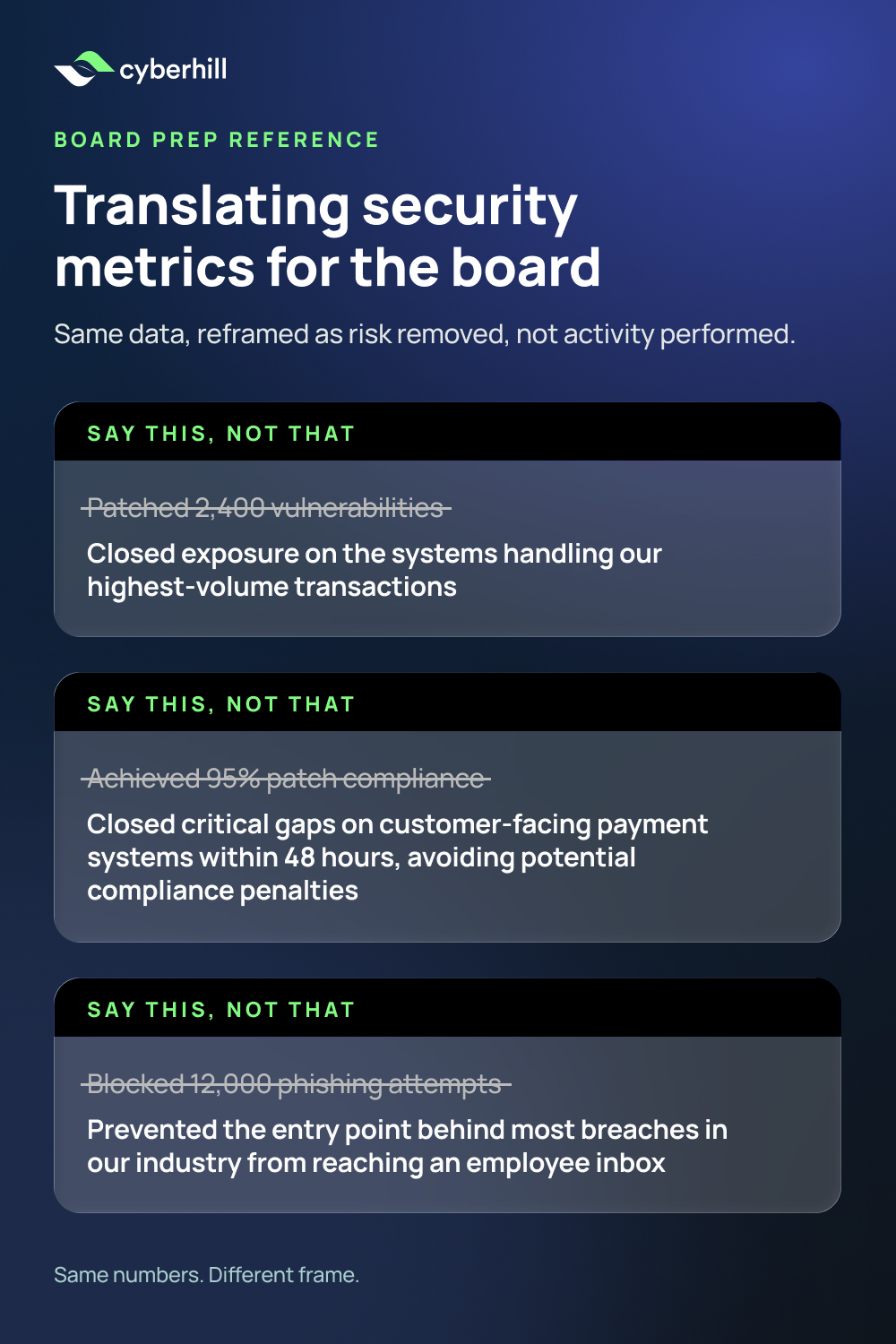
None of these require inventing numbers. They require translating the numbers the security team already has into the coverage and risk language the board already understands. That's the whole exercise: same data, different frame.
This is also where most board presentations quietly fail. Even teams that know their metrics well default back to activity language under pressure, because it's what they're used to reporting internally. Building the translation ahead of time, not improvising it in the meeting, is what keeps the case in business terms instead of sliding back into security terms.
Why Point-in-Time Audits Fall Apart Three Months Later
A board approves budget based on the picture in front of them that day. The problem is that picture stops being accurate almost immediately. New tools get added. Vendors change. Cloud environments shift weekly. The cost, coverage, and risk numbers presented in Q1 are already stale by the time the CISO is back in the room for Q3, and rebuilding that picture from scratch every cycle is exactly the manual, weeks-long process that made the case hard to make in the first place.
This creates a credibility problem that has nothing to do with the original presentation. The board remembers the numbers from last time. If the next conversation opens with a different picture and no clear explanation of what changed and why, it reads as inconsistency, not progress. The CISO ends up re-litigating the basics instead of building on what was already approved.
The alternative isn't presenting more often. It's not needing to rebuild the picture every time, because the underlying view of cost, coverage, and risk stays current between meetings instead of going stale the moment the slide deck is closed.
Getting a Live View of Cost, Coverage, and Risk
A static framework solves the language problem. It doesn't solve the staleness problem. For the Cost, Coverage, Risk model to hold up meeting after meeting, the underlying picture needs to update as the environment changes, not get rebuilt by hand every time the board wants an answer.
This is the gap Wolverine closes. It maintains a continuously updated digital twin of the enterprise tech stack, so the cost, coverage, and risk view isn't a snapshot assembled ahead of a meeting. It's a live picture of what's being spent, what it protects, and what's still exposed, updated as the stack itself changes.
In practice, that changes what the CISO walks into the room with. Instead of a deck built from a manual audit that was accurate a month ago, the presentation reflects the current state of the environment. When the board asks what changed since last quarter, the answer is already there instead of requiring another few weeks of assessment to produce.
The framework tells you what to say. Wolverine is what keeps what you're saying true between meetings.
Build Your Next Board Case on Cost, Coverage, and Risk
A board doesn't need more security data. It needs the data it already gets framed in terms it can act on, kept current enough that every conversation builds on the last one instead of starting over. Cost, Coverage, Risk gives you that structure. Wolverine keeps it true between meetings.
If your next board presentation is still built from a manual audit and a static slide deck, talk to our team about Wolverine and see what a live view of your cost, coverage, and risk actually looks like.
Proving Cybersecurity ROI to Your Board: FAQs
What is the Cost, Coverage, Risk framework?
A structure for presenting security spend to a board using three questions: what's being spent, what it protects, and what risk remains once that spending is accounted for. It replaces technical scorecards with a case a board can evaluate the same way it evaluates any other capital request.
Why does admitting residual risk make a security case more credible, not less?
A presentation that shows only what's working reads as incomplete to a board trained to look for what isn't being said. Naming the risk that's still open, even after investment, signals the CISO has a full picture rather than a curated one, which is what boards are actually trying to assess.
Does a live view of cost, coverage, and risk replace the need for board presentations?
No. The framework still has to be presented and discussed. What changes is what the presentation is built from. Instead of a manual audit assembled ahead of the meeting, the numbers reflect the current state of the environment, so the conversation is about the risk itself rather than whether the data is still accurate.
How is this different from a typical cyber risk quantification model?
Most risk quantification frameworks stop at estimating financial exposure. Cost, Coverage, Risk goes one step further by tying that exposure directly to what's currently deployed and what it covers, which is the piece that usually requires a fresh audit to answer. Wolverine maintains that mapping continuously as a digital twin of the tech stack, so the exposure estimate and the coverage picture stay attached to each other instead of drifting apart between assessments.
What happens between board meetings if the environment changes?
In a manual process, nothing, until the next audit catches up. With a continuously updated view, changes to the stack, new tools, vendor shifts, and cloud changes get reflected in the cost, coverage, and risk picture as they happen, so the next board conversation starts from where the last one left off instead of from a data-gathering exercise.
Is this framework specific to any single tool or platform?
The Cost, Coverage, Risk structure works with any data source; it's a way of organizing the conversation, not a proprietary format. What Wolverine adds is keeping that structure populated with live data rather than requiring it to be rebuilt each time manually.