
At financial institutions, compliance reporting is a control function with legal consequences. Reports submitted to regulators must be accurate, defensible, and supported by a clear record of how the underlying data was gathered and validated. Regulators can ask firms to explain specific figures, document reporting decisions, and demonstrate the controls behind the process.
Regulatory pressure is one reason automated reporting has become a major focus across banking, capital markets, insurance, and other regulated sectors. It also reshapes who carries the work. Automation handles the mechanical steps, but the people who sign and defend these filings still decide what goes out.
Firms that get this right automate the routine steps so their people can focus on judgment calls that require a human. Here’s what that looks like in practice, where the limits are, and how to start.
What Is Being Automated in Compliance Reporting Today?
KYC and AML Monitoring
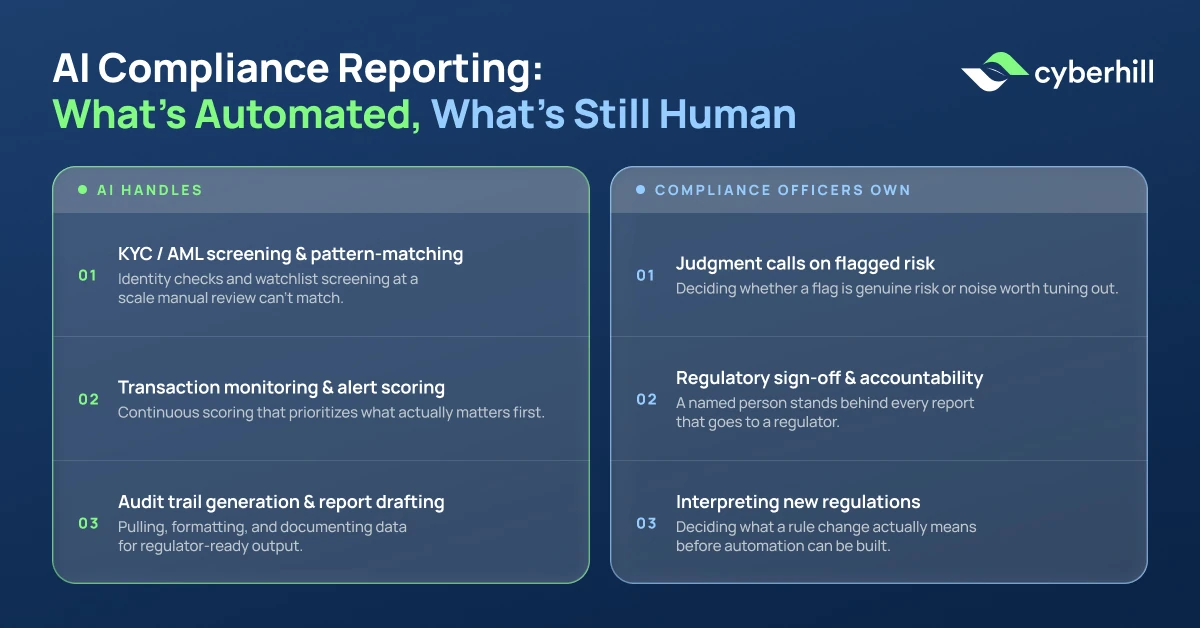
Know Your Customer and anti-money laundering checks involve pulling identity data, screening against watchlists, and flagging suspicious patterns across huge transaction volumes. AI models handle the screening and pattern-matching at a scale manual review can't match, cutting down the backlog of alerts that need a human look. The tradeoff historically has been false positives: legacy rule-based systems flag far more than they should, burying real risk in noise. Better-tuned AI models reduce that noise without reducing coverage, which is where a lot of the practical value shows up.
Transaction Monitoring and Alert Triage
Real-time transaction monitoring used to mean periodic batch reviews that were already stale by the time anyone looked at them. AI-driven monitoring runs continuously, scoring transactions as they happen and prioritizing alerts by actual risk rather than treating every flag the same. This doesn't eliminate the alert queue. It changes it from "review everything in order" to "review what actually matters first."
Audit-Ready Documentation and Report Drafting
Generating the report itself, pulling data from source systems, formatting it to a regulator's schema, and building the audit trail that shows where every number came from is exactly the kind of repetitive, format-heavy work AI automates well. The output still needs sign-off, but the manual data-wrangling that used to consume most of the preparation time gets compressed significantly.
Which Parts of Compliance Reporting Still Need Human Review?
None of this replaces the compliance function. Where a model flags a transaction as high-risk, someone still decides whether it's genuinely suspicious activity or a false positive worth tuning out. Where a report needs to go to a regulator, someone still signs it. Where a new regulation changes what needs to be reported, someone still interprets what that means for the business before any automation can be built around it.
The parts of the job that involve interpreting ambiguous situations, making judgment calls under uncertainty, and taking accountability for a regulatory filing stay with people. What's changed is how much manual groundwork a compliance officer has to do before they can apply that judgment. AI handles the groundwork. People still own the decision.
The Regulatory Frameworks Shaping AI-Driven Reporting
SOX and DORA are two frameworks to consider where applicable. SOX addresses internal control over financial reporting for covered issuers, while DORA addresses digital operational resilience for in-scope EU financial entities. Neither prescribes a specific AI technology.
Sarbanes-Oxley (SOX)
For covered issuers, SOX Section 404 requires management to assess and report on internal control over financial reporting, with evidence supporting that assessment. AI-driven financial-reporting processes should have risk-appropriate controls, which may include:
- Segregating incompatible duties or using compensating controls
- Logging relevant data changes, approvals, and automated processing
- Retaining evidence sufficient to support the assessment of control effectiveness
DORA (Digital Operational Resilience Act)
Focused on operational resilience rather than reporting accuracy. In-scope institutions need to show that:
- ICT systems, including AI tools doing compliance work, can withstand disruption
- ICT third-party arrangements are appropriately risk-assessed
- Major ICT-related incidents are reported to competent authorities within prescribed deadlines
An AI compliance tool isn't exempt from this. It's one more system that has to be governed, tested, and accounted for in the resilience plan.
The throughline: regulators care less about which technology is used and more about whether the process is auditable, explainable, and resilient to failure. That's the design bar for any AI-driven reporting workflow, regardless of which additional frameworks apply to a given institution.
What Are the Risks of Automating Regulatory Reporting With AI?
Automation doesn't remove risk from compliance reporting. It relocates it. The failure modes look different than manual-process failures, and they're worth naming honestly rather than glossing over.
Explainability
A model that flags a transaction or generates a report entry needs to be able to show why. If a regulator asks how a number was produced or why a customer was flagged, "the model decided" isn't an answer. This is the essence of AI explainability: reporting workflows built on AI need a clear path back from output to reasoning, not just from output to source data.
Model Governance
Models drift. A system tuned correctly at launch can start producing different outputs six months later as underlying data patterns shift, and nobody notices until an audit or a regulator catches it. Ongoing monitoring, versioning, and revalidation aren't optional extras. They're what keeps an AI system compliant after go-live, not just at go-live.
False Positive Reduction Cuts Both Ways
Reducing false positives is one of the clearest wins AI offers over legacy rule-based monitoring. It's also where overcorrection is easy to miss. A model tuned aggressively to cut noise can quietly start missing real risk, and that failure mode is harder to catch than a flood of false alerts, because it looks like things are working.
Vendor and Third-Party Risk
Most financial institutions aren't building compliance AI in-house. They're buying it. That means the model's governance, explainability, and audit trail are only as strong as what the vendor provides in reality, not what the institution assumes it's getting. This is a diligence question to ask before signing, not after an incident.
None of this means you can’t automate compliance reporting, but it does mean the tool has to be built with the same rigor applied to any other system a regulator can ask questions about.
How Financial Services Firms Are Getting Started
Most firms don't start by automating everything at once. They start by finding the one reporting process that eats the most manual hours and has the clearest paper trail to build around.
1. Identify the Highest-Effort Process First
Look for the report that requires pulling data from the most systems, involves the most manual reconciliation, or has the tightest deadline relative to the effort it takes. That's usually KYC refresh cycles, transaction monitoring alert queues, or a specific recurring regulatory filing. Starting here makes the ROI obvious quickly, which matters for getting the next phase funded.
2. Pilot Narrow, Not Broad
A single process, one regulatory framework, one business unit. Trying to automate compliance reporting enterprise-wide on day one means no one can isolate what's working vs. what's just adding noise. A narrow pilot also makes it easier to validate explainability and audit trail requirements before scaling, rather than discovering a gap after the system is already load-bearing.
3. Build for Audit From the Start, Not After
Retrofitting audit trail and explainability requirements onto a system that's already running is harder than building them in from the first deployment. Whatever gets automated first should be able to answer "why did this happen" and "prove this is accurate" from day one, since that's the bar any AI-driven reporting process eventually has to clear anyway.
4. Expand Based on What the Pilot Proves
The second and third processes to automate should be chosen based on what the pilot demonstrated, not a pre-built roadmap. If the pilot showed strong false-positive reduction on transaction monitoring, that's a signal to expand into adjacent monitoring use cases before jumping to something unrelated like report drafting.
This is also where the tooling question becomes concrete: a firm evaluating AI for financial services compliance needs a system built around industry-specific context, not a generic automation layer retrofitted for regulated use. That's the case for purpose-built, industry-specific AI over general-purpose automation bolted onto a regulated workflow.
Turning Compliance Reporting Into a Competitive Advantage
The firms getting the most out of AI in compliance reporting aren't the ones automating the most. They're the ones automating the right processes first, building explainability and audit trails in from day one, and keeping human judgment on the decisions that need it. That combination is what turns compliance from a cost center firms tolerate into a function that moves as fast as the rest of the business.
The regulatory bar isn't going to get lower, and reporting volume isn't going to shrink. Firms that build this capability now aren't just cutting manual hours. They're building the audit-ready, explainable foundation that every future regulation is going to demand anyway.
See What This Looks Like for Financial Services
Explore how Cerebro applies industry-specific context to compliance reporting, transaction monitoring, and audit readiness for financial services firms.
Book a Use Case SessionRegulatory Reporting Automation in Financial Services: FAQs
Is regulatory reporting automation the same thing as AI in compliance?
Not exactly. Regulatory reporting automation is the broader category: workflows, data pipelines, and rules-based systems that produce and submit reports to regulators. AI is one layer within that, handling the parts that involve pattern recognition or judgment at scale, like flagging anomalies or drafting report sections. A firm can automate reporting without AI. Most firms doing it well today use both together.
What does an AI-driven compliance reporting workflow look like in practice at a bank or asset manager?
Data gets pulled automatically from source systems, an AI layer screens for KYC/AML risk or scores transactions for anomalies, and the system generates a draft report with a full audit trail attached. A compliance officer reviews the flagged items and drafted output, makes the judgment calls, and signs off. The manual data-gathering step that used to take days now takes hours or less.
Where does responsibility sit when a report includes AI-generated output?
With the compliance officer who signs it, not the model. Regulators hold institutions accountable for what gets filed regardless of what tooling produced it, which is exactly why explainability and audit trails matter as much as accuracy. If a firm can't show how an AI-assisted number was derived, that's a governance gap, not a technology limitation.
Does using AI make audits easier or harder?
Easier, when it's built correctly. AI systems that log every transformation and decision create a more complete audit trail than manual processes ever did. It gets harder fast if the system was deployed without that logging in place from the start, since retrofitting an audit trail onto a black-box process is far more work than building it in from day one.
Which specific regulations should shape how a firm builds its AI compliance reporting process?
Relevant frameworks depend on the institution’s activities and jurisdiction. SOX addresses internal control over financial reporting for covered issuers, while DORA addresses digital operational resilience for in-scope EU financial entities. AML, data privacy, and sector-specific reporting requirements may also apply. The design principle stays constant across all of them: auditable, explainable, resilient to failure.
Will AI eventually handle regulatory reporting without human involvement?
Unlikely in any near-term sense, and not because the technology can't process the data. Regulators expect a named, accountable person behind every filing, and judgment calls about ambiguous risk will keep requiring human sign-off. What's realistic is AI handling a growing share of the groundwork while people spend more of their time on review and decision-making rather than data assembly.
What goes wrong when firms automate compliance reporting without addressing model governance?
Models drift silently. A system that performs well at launch can start producing different results as data patterns shift, and without ongoing monitoring, nobody notices until an audit flags an inconsistency or a regulator asks a question the firm can't answer. Model governance is an ongoing operational requirement.
What's a realistic first step for a firm that hasn't automated any compliance reporting yet?
Pick the single reporting process that consumes the most manual hours and has a clear, well-understood paper trail, often a recurring KYC refresh or a specific regulatory filing, and pilot AI there before touching anything else. A narrow, well-instrumented pilot proves out explainability and audit readiness in a contained way, and gives the firm a real basis for deciding what to automate next.