The pilot cleared its accuracy targets. The demo landed with stakeholders. Budget got approved to take it enterprise-wide. Then, at rollout, it stalled — not with an outage or a headline, but with integration delays, a governance review that never closes, and a business case nobody can defend by month six.
MIT's Project NANDA analyzed 300 public AI deployments and interviewed more than 150 business leaders and found that 95% of enterprise generative AI pilots fail to deliver measurable ROI and only about 5% generate a measurable P&L impact. The researchers' explicit conclusion: the divide is caused by what they call a "learning gap" between how AI is piloted and how it has to function once it's running inside a real organization.
That's the reframe this piece works from: stop diagnosing the model, start diagnosing the gap between pilot conditions and production conditions. Two independent bodies of research, MIT's NANDA study and a 2024 RAND Corporation report based on 65 structured interviews with experienced AI/ML engineers, converge on the same conclusion from different angles. RAND's research puts the overall AI project failure rate above 80%, roughly twice the rate for non-AI IT projects, and found that leadership- and data-driven issues account for the overwhelming majority of it.
What RAND's Research Says Actually Breaks
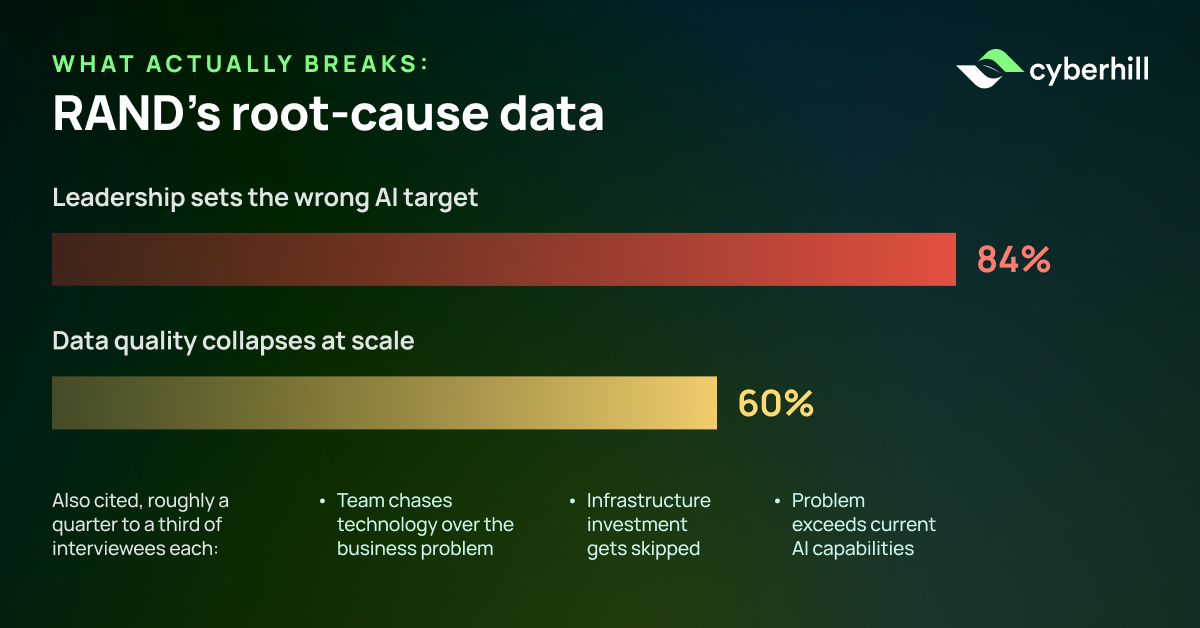
RAND's interviewees didn't point to model performance as the leading cause of failure. They pointed to five specific, recurring patterns:
- 1.Leadership sets the wrong target. 84% of interviewees cited leadership-driven failures as a top cause. Most often, business leaders asking for a model optimized for the wrong metric (e.g., "the price that sells the most units" instead of "the price that maximizes margin") or underestimating how long it takes to acquire and clean data before a model can be trained at all.
- 2.Data quality collapses at scale. 30 of 50 industry interviewees named data quality as a persistent, primary failure driver. Not because data was absent, but because data collected for compliance or reporting purposes (e.g., weekly sales logs) often lacks the structure and context an AI model needs to reason over it.
- 3.Teams chase technology instead of the business problem. Newer models and frameworks get adopted because they're interesting to build with, not because they're the best fit for the use case — a pattern RAND's interviewees flagged as a frequent, avoidable cause of scope drift.
- 4.Infrastructure investment gets skipped. Without pipelines to continuously clean, monitor, and move data, teams are often unable to detect degradation after deployment or can't move a model from test to production environments at all because the two were never built to be compatible.
- 5.The problem was too hard for AI in the first place. A smaller, but real, share of failures where the task exceeded what the technology could reliably do, regardless of how it was implemented.
Only one of these five root causes is about the technology itself. The other four are about how the organization defined the problem, prepared its data, resourced the work, and built the infrastructure around the model, before the model was ever asked to run in production.
What Changes Between Pilot and Production
A pilot is built to succeed under narrow conditions: a curated dataset, one team's workflow, a data scientist manually checking outputs in real time. Production removes all three constraints simultaneously — the dataset becomes whatever the enterprise actually has (inconsistent formats, missing fields, records split across systems that were never designed to sync), the workflow expands to every team and edge case at once, and the manual safety net disappears because no one can eyeball every output at enterprise volume.
Gartner predicts that, through 2026, organizations will abandon 60% of AI projects unsupported by AI-ready data, and found that 63% of organizations either lack, or are unsure they have, the right data management practices in place to support AI at all.
"AI-ready" is a materially stricter standard than "reporting-ready." A dataset good enough for a monthly dashboard is frequently not good enough to feed a model making decisions in real time, because it was never built with consistent structure, active governance, or a shared definition of what each field actually means across departments. That gap is invisible in a pilot — one team already knows what its own data means. It becomes visible the moment the model has to reason across a second or third team's data, using their conventions instead.
Why the Failure Reads as Technical When It Isn't
RAND's interviewees were explicit on this point: AI projects have both a technology component and an organizational component (process, ownership, approval structure), and failures in the second category get misattributed to the first because that's the easier story to tell. A pilot can move fast because it doesn't need six departments to sign off. Production does, and when nobody defined (before the pilot started) who owns the model, who approves changes to it, or how its outputs get audited, the rollout stalls in review rather than in code.
This is also where "shadow AI" shows up in practice: employees who saw real value in the pilot start routing work around a stalled approval process using ungoverned tools to get the same result faster. That's evidence the approved path can't keep pace with the demand the pilot itself created.
The Precondition Nobody Pilots For
Across both bodies of research, the fix isn't a better model — it's building three things before the pilot starts, not retrofitting them after it succeeds:
- 1.A shared semantic layer. A consistent, machine-readable definition of what "customer," "region," or "risk" means across every system it touches, so a model doesn't have to relearn those definitions (or produce inconsistent answers) every time it crosses a department boundary.
- 2.Governance designed alongside the model, not after it. Model ownership, change approval, and audit processes need to scale at the same pace as the AI itself, or review becomes the bottleneck the moment the AI is asked to do more.
- 3.Explainability built in, not bolted on. The ability to show why a system produced a given output (not just that it did) before legal or compliance asks for it during scale-up, not after.
RAND's report frames this directly: underinvestment in infrastructure is one of the clearest, most fixable predictors of failure, and organizations that build data and deployment infrastructure up front consistently move faster and fail less than organizations that rebuild it project by project.
Five Things to Put in Place Before You Pilot
- 1.Assess data readiness for the specific use case the AI will run against, not general data availability. A dataset that supports weekly reporting is not automatically ready to train or feed a production model.
- 2.Name an executive sponsor and a governance owner before the pilot starts, not once it's time to scale. RAND's research found that unclear ownership and shifting leadership priorities were among the most cited, and most damaging, causes of failure.
- 3.Build the semantic/ontology layer as shared infrastructure, so each new AI use case draws on a common foundation instead of rebuilding data definitions from scratch.
- 4.Design the audit trail alongside the model, so explainability is native to the system rather than a retrofit under compliance pressure.
- 5.Set a realistic timeline up front. RAND's interviewees repeatedly flagged that leaders expect AI projects to take weeks when they typically take months to a year, and pilots get abandoned before they've had the chance to prove out, not because they failed, but because they were judged against a schedule no AI project could meet.
The Gap Is Closeable
The organizations quietly scaling AI successfully aren't succeeding because they found a better model, both MIT's and RAND's research point the same direction: they treated the pilot-to-production gap as an architecture and governance problem to solve before piloting, not a surprise to manage afterward.
That's the approach Cerebro is built around: an ontology-driven foundation for enterprise AI that treats the semantic layer, governance, and explainability as infrastructure from day one — so scaling past the pilot isn't a separate, painful rebuild. It's what the system was designed to do from the start.
If your last pilot worked but stalled at rollout, the problem probably isn't the model you built. It's what wasn't built underneath it.
Ready to Talk Through Where Your AI Initiatives Are Getting Stuck and What It Would Take to Close the Gap?
Book a Use Case SessionAI Pilot to Production: FAQs
What is the AI pilot-to-production gap?
The AI pilot-to-production gap is the drop-off between an AI pilot that performs well in a controlled test and its ability to function reliably once deployed enterprise-wide. The gap is typically caused by organizational factors like data readiness, governance, ownership, and infrastructure, rather than by the underlying AI model itself.
What percentage of AI pilots fail to reach production?
Estimates vary by study, but land in a similar range: RAND Corporation research puts the overall AI project failure rate above 80%, while MIT's Project NANDA found that 95% of enterprise generative AI pilots fail to deliver measurable ROI.
Is AI pilot failure a technology problem or an organizational problem?
Research consistently points to organizational causes over technical ones. RAND's interviews with AI/ML engineers found that leadership misalignment and data readiness were cited far more often than model performance as the primary reasons AI projects fail to scale.
Why does an AI pilot's data quality matter more at production scale?
A pilot typically runs on a curated, single-team dataset that's easy to keep clean. Production requires the same model to reason across data from multiple teams and systems (often inconsistent, incomplete, or governed differently) which is where quality problems that didn't show up in the pilot start to surface.
What is an AI-ready data foundation?
An AI-ready data foundation is a data environment with consistent structure, active governance, and shared definitions across systems: a stricter standard than data that's simply "reporting-ready." Gartner has estimated that a majority of organizations either lack, or are unsure they have, the data management practices needed to meet this standard.
How long does it typically take to move an AI pilot to production?
There's no fixed timeline, but enterprise AI research consistently finds that leadership expectations run shorter than reality, projects that take months to a year to show sustained impact are frequently abandoned within weeks or months because they're judged against an unrealistic schedule.
What's the difference between an AI proof of concept and a production-ready AI system?
A proof of concept is scoped to prove that an idea works under ideal conditions. A production-ready system is built to hold up under real conditions like messy data, cross-team dependencies, and governance requirements, which typically requires infrastructure (a semantic layer, audit trails, defined ownership) that a proof of concept was never designed to include.