An AI system can be accurate and still fail your organization. If a model approves a loan, flags a transaction, or recommends a hire, and no one can explain why, that system is a liability the moment someone asks a hard question. The person asking might be a regulator, a board member, or a customer disputing a decision. "The model said so" is not an answer any of them will accept.
This is what explainable AI actually addresses: not just making AI outputs understandable in theory but making them defensible in practice. This guide covers what explainability means, where the stakes show up first, and what separates a model that's accurate from one your organization can actually stand behind.
What Is Explainable AI?
Explainable AI (XAI) is a set of techniques and processes that make an AI system's outputs understandable to the people who have to act on them, defend them, or answer them. That includes which inputs drove a result, why the system chose one output over another, and how confident it is in that result.
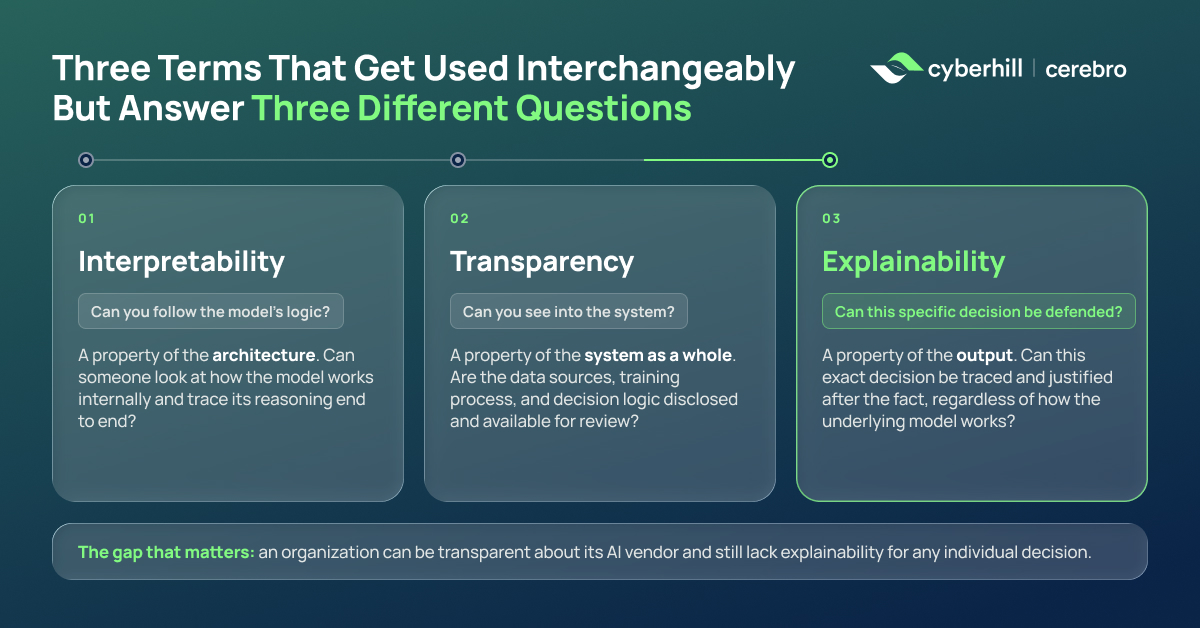
The term gets used interchangeably with a few others that mean different things:
- Interpretability describes the model itself. Can someone look at how it works internally and follow the logic? This is a property of the architecture.
- Transparency describes visibility into the system as a whole. Are the data sources, training processes, and decision logic disclosed and available for review?
- Explainability describes the output. Can this specific decision be traced and justified after the fact, regardless of how the underlying model works?
An organization can have transparency about its AI vendor and still lack explainability for any individual decision. The distinction matters because most AI governance conversations start with the wrong one. Executives ask, "Is our AI transparent," when the question that actually determines audit readiness is, "Can we explain this specific output?"
This is also where retrieval-based systems create a false sense of security. A RAG pipeline can cite its sources and still produce an answer that doesn't accurately reflect what those sources said. Explainability isn't solved by showing your work. It requires the work to be traceable from end-to-end.
Where the Stakes Show Up
Explainability problems surface first wherever an AI decision touches a person's outcome, and that's rarely engineering. It's a regulator asking for a decision trail, a board member asking why the company approved a use case it can't defend, or a customer disputing a denial with no clear reason attached.
A few scenarios where this plays out concretely:
- Credit and lending. A model denies an application. The applicant has a legal right to know why, and "the algorithm decided" doesn't satisfy that requirement in most regulated markets.
- Hiring. An AI tool screens candidates and disproportionately filters out one group. Without a traceable decision path, the organization can't identify whether that's bias and can't defend against a claim that it is.
- Healthcare. A diagnostic or triage recommendation influences patient care. Clinicians need the reasoning, not just the output, to trust and act on it.
Regulatory pressure is accelerating this timeline. One source indicates that the EU AI Act's transparency provisions took effect in August 2026, with penalties reaching into the tens of millions of euros for high-risk systems that can't demonstrate traceability.
The pattern across all of these is that the technical team built a working model, and a non-technical stakeholder (a regulator, a board, a customer) has to accept or reject its output. That's the same gap organizations run into when they try to justify a cybersecurity investment to a board that doesn't think in technical terms. The audience isn't equipped to evaluate the mechanism. They need the reasoning translated into something they can act on.
Accurate Isn't the Same as Auditable
A model can hit its accuracy targets and still be unauditable. Accuracy measures whether the output is right. Auditability measures whether anyone can prove it, after the fact, to someone who wasn't in the room when the model was built, and often isn't a data scientist at all.
Most organizations only build for the first one. Precision, recall, and F1 scores tell you how well a model performs against a test set. None of them tell you why a specific decision came out the way it did for a specific input, on a specific date, using a specific version of the model. That's the actual question a regulator, auditor, or disputing customer asks, and it's a different question entirely.
A real audit trail must reconstruct that moment. At minimum, that means:
- The exact input data used for that decision, not a representative sample
- The model version and configuration in effect at that time, since most production models get retrained or tuned on a cadence
- The logic or rules that applied, whether that's feature weighting, an ontology match, or a decision rule
- The output produced, and the confidence or reasoning attached to it
- Who or what reviewed it, if a human checkpoint existed in the workflow
Miss any one of those, and the trail breaks. A model retrained monthly without version-locked logging can't tell you what it was doing three months ago, only what it does today. That's a common gap, and it's invisible until someone asks a question that reaches back further than the current model version.
Ownership tends to break down along the same lines. Data science teams are measured on model performance, not on whether last quarter's decisions are reconstructable. Compliance teams are measured on regulatory posture but usually lack the technical access to pull a decision trail themselves. IT owns infrastructure and uptime, not decision logic. Frameworks like NIST's AI Risk Management Framework try to close this gap by assigning explicit governance functions, but adopting a framework on paper doesn't automatically mean a system was built to produce the trail that framework requires.
This is also why AI pilots stall before reaching production. A model clears every technical benchmark, then gets stuck in review because no one can produce a trail for how a specific decision was made, and no one owns fixing that after the fact.
Auditability isn't a report generated after the fact. It's a property the system either has or doesn't, built into how it stores and traces decisions from the start. That distinction separates systems that organizations can deploy at scale from those that stay stuck in pilot.
Building Explainability into the Architecture
Most explainability efforts get added after the model is already built. A team ships a system, then layers on a dashboard, a report, or a documentation process to explain what it already did. That approach treats explainability as paperwork. It's disconnected from the system itself, and it breaks the moment someone asks a question the report didn't anticipate.
Cerebro takes a different approach by building explainability into the architecture itself. It's ontology-driven, meaning every output is grounded in a structured, traceable map of how data, entities, and decisions relate to each other, rather than surfaced from a black-box model and explained secondhand. When a decision needs to be defended, the trail already exists. Nobody has to reconstruct it from logs or reverse-engineer a model's reasoning after the fact.
That same architecture decision is also what makes Cerebro faster and cheaper to stand up than the alternative most enterprises assume they're stuck with: a custom, Palantir-style ontology build that takes a specialized team months or years to complete.
What the Architecture Changes in Practice
- Client-owned IP. The ontology and the logic built on top of it live in the client's environment. It's an asset the enterprise owns and can build on, not a black box licensed from a vendor.
- No migration required. Cerebro connects to the data and systems already in place instead of requiring a rip-and-replace implementation or a data migration project before it can run.
- Days, not months, to deploy. Because there's no migration step, standing up Cerebro takes days rather than the multi-month timelines typical of bespoke ontology engagements.
- A fraction of the cost of a custom build. Enterprises get the same ontology-driven foundation that would otherwise require a multi-year, seven-figure build, without the build.
This is the practical difference between a system that's explainable and one that just produces explanations on request. The first holds up under real audit pressure, from a regulator, a board, or a customer who wants a straight answer. The second holds up until someone asks a question it wasn't built to handle.
For a closer look at how this plays out in a regulated industry, see how Cerebro's approach applies to financial services decisioning.
What to Look for in a Genuinely Explainable System
Vendors describe almost everything as "explainable" now. The term has lost precision, which means the burden is on the organization evaluating a system to ask sharper questions than the marketing copy answers.
A few ways to tell a genuinely explainable system from one that's explainable in name only:
Ask Whether the Trail Exists Before the Audit, Not Because of It
A system that can only produce an explanation when someone specifically requests one is retrofitting, not explaining. Ask the vendor to show you a decision trail for an arbitrary, unprompted example. If that takes engineering effort to generate, the trail isn't a built-in property.
Ask Who Can Access the Explanation and How
A model that only a data scientist can interpret hasn't solved the problem for the board, the regulator, or the customer who actually needs the answer. A genuinely explainable system produces reasoning that a non-technical stakeholder can act on without a translator.
Ask What Happens When the Model Changes
Retraining and version drift are normal. What isn't normal is losing the ability to explain decisions made under a previous version. Ask specifically how past decisions stay traceable after an update.
Ask Where the Explanation Comes From
Some systems generate a plausible-sounding explanation that isn't actually derived from the logic that produced the decision. That's an explanation-shaped output, not a real one. The reasoning should trace back to the same structure that made the decision, not a separate model summarizing it after the fact.
Ask What Happens Under Dispute
If a customer or regulator formally challenges a decision, find out what the organization can actually produce. If the honest answer is "we'd have to look into it," the system isn't audit-ready today, regardless of what the sales deck claims.
These questions work whether you're evaluating a vendor or auditing a system your own team already built. The pattern to watch for is the same either way: explainability that exists by default versus explainability that gets manufactured under pressure.
Start Asking These Questions Before You Deploy
Explainability isn't a feature you bolt on once a regulator or board member asks for it. By then, the model's already in production, the trail may not exist, and reconstructing it after the fact is far harder than building it in from the start.
The organizations that handle this well treat it as an architecture decision, not a documentation task. They know who owns the audit trail before a dispute forces the question. They can produce a decision's reasoning without scrambling to reverse-engineer it from logs. And they evaluate AI systems, whether built internally or bought from a vendor, against the questions in this guide before they're locked into one that can't hold up under scrutiny.
If your organization is deploying AI in a regulated function and can't yet answer "how would we prove this decision was sound," that's the gap worth closing next.
See How Cerebro Builds Explainability in from the Start
Cerebro's ontology-driven architecture traces and audits AI decisions by design, not through a report generated after the fact. See how it applies to your organization's AI deployments.
Book a Use Case SessionExplainable Enterprise AI: FAQs
What is explainable AI (XAI)?
Explainable AI is a set of techniques and processes that make an AI system's outputs understandable, specifically which inputs drove a result, why the system chose that output, and how confident it is, to the people who have to act on or defend that decision.
What's the difference between explainable AI and interpretable AI?
Interpretability describes the model itself: whether someone can follow its internal logic. Explainability describes the output: whether a specific decision can be traced and justified after the fact, regardless of how the model works internally.
Why does explainability matter for regulated industries?
Regulators increasingly require organizations to demonstrate how automated decisions were made, particularly in lending, hiring, and healthcare. Without a traceable decision path, organizations can't defend a decision or prove it wasn't biased.
What's the difference between an accurate AI system and an auditable one?
Accuracy measures whether an output is correct. Auditability measures whether that output can be reconstructed and proven sound after the fact, including the exact inputs, model version, and logic in effect at the time.
Can explainability be added to an AI system after it's already built?
Partially, through documentation and reporting layers, but that approach breaks under unanticipated questions. Genuine explainability is a property of the architecture, built into how decisions are traced and stored from the start.