
A security assessment is only as accurate as the day it was run. The moment it's finished, your environment keeps changing. New code ships, cloud configurations shift, vendors get added, and access permissions expand. By the time the report lands in an inbox, it's already describing a version of your stack that no longer exists.
This is the core limitation of point-in-time security assessments. They were built for a slower era of enterprise IT, when infrastructure changed on a quarterly release cycle instead of daily. Most enterprise stacks don't work that way anymore, and treating an annual pentest or a quarterly compliance review as an accurate picture of current risk creates a gap that grows wider every day between assessments.
The fix is to pair scheduled assessments with continuous visibility into how your security environment changes in between. Below, we'll cover where point-in-time assessments fall short, what continuous security monitoring looks like in practice, and how enterprises can close that gap without adding another disconnected tool to their stack.
What Counts as a Security Assessment Today?
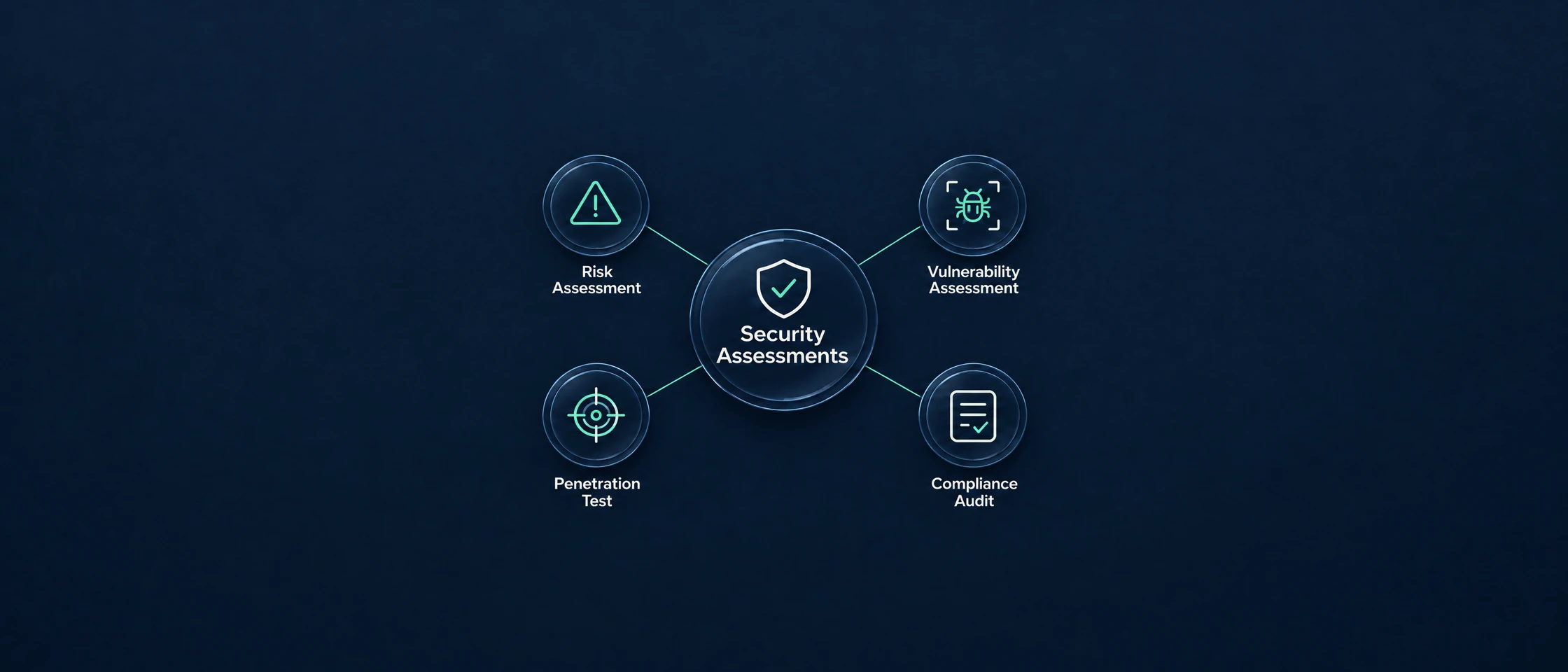
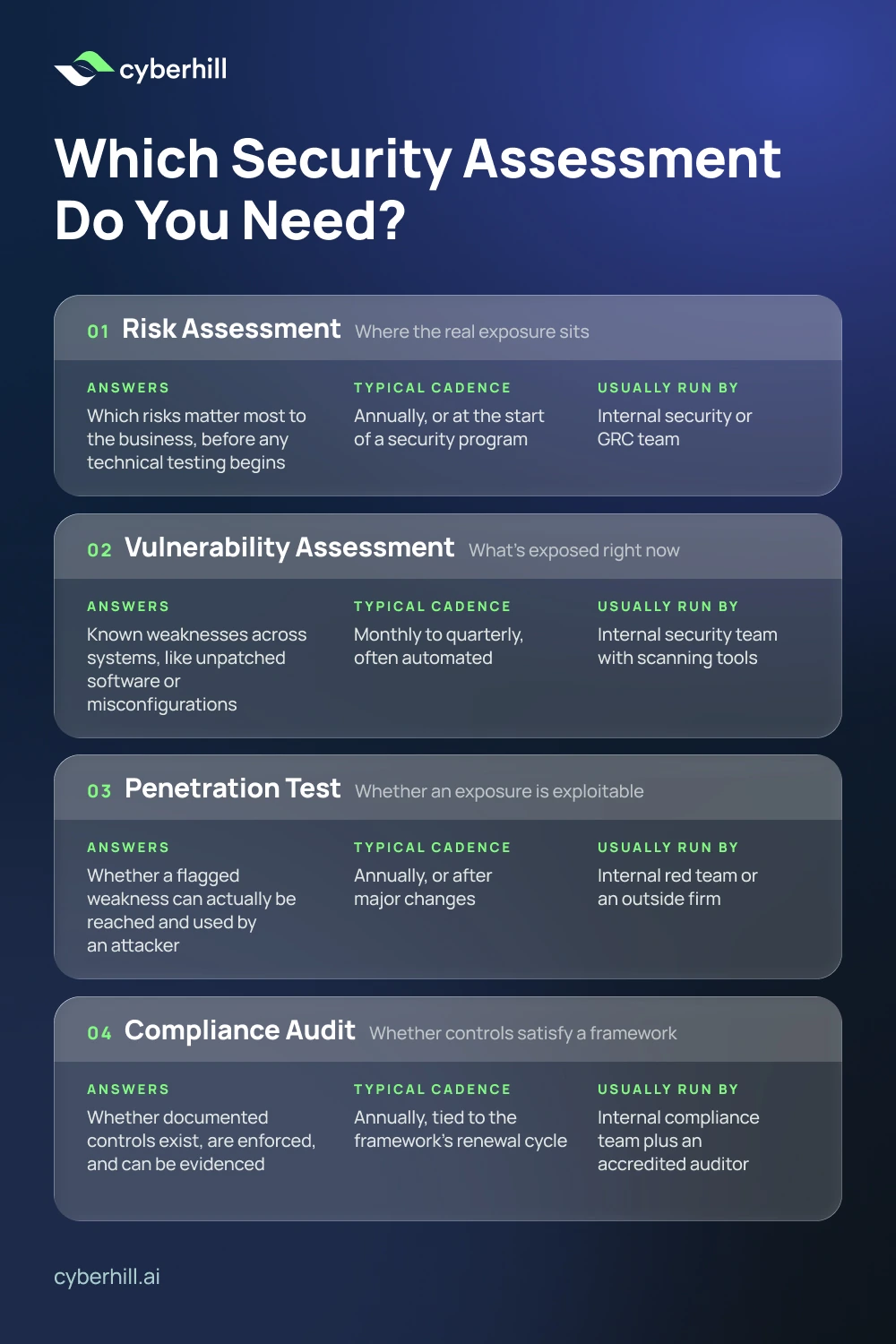
Security assessment is a broad term encompassing several different evaluation types, and those differences matter when determining what your business actually needs.
Risk Assessment
A risk assessment identifies and prioritizes threats to specific information assets, weighing likelihood against potential impact. It's typically the starting point for a security program, since it determines where the real exposure sits before any technical testing begins.
Vulnerability Assessment
A vulnerability assessment scans systems for known weaknesses like unpatched software, misconfigured cloud storage, or outdated encryption protocols. It's largely automated, which makes it fast and repeatable, but it stops at identification. It won't tell you whether a flagged weakness is reachable by an attacker.
Penetration Test
A penetration test goes further, simulating a real attacker's attempt to exploit those weaknesses and gain access. Where a vulnerability scan says, "This could be a problem," a pentest tries to prove it is one, often chaining smaller weaknesses together into a real attack path. This is also the most resource-intensive of the four, usually run by a dedicated internal red team or an outside firm over a defined engagement window of one to several weeks.
Compliance Audit
A compliance audit evaluates whether controls meet the requirements of a specific framework, such as SOC 2, PCI DSS, or HIPAA. It's less concerned with whether a system can be broken into and more concerned with whether documented controls exist, are enforced, and can be evidenced to an auditor. This is usually the assessment type tied most directly to a business outcome: passing it can be a condition of closing a deal or renewing a contract.
How They Work Together
Each of these answers a different question, which is why most mature security programs run more than one. A vulnerability scan tells you what's exposed. A penetration test tells you whether that exposure is exploitable. A risk assessment tells you which of those exposures actually matter to your business. A compliance audit tells you whether your controls satisfy a regulator or customer.
They share a common structure: each one is scoped to a defined set of systems, scheduled according to the applicable framework, contract, and risk level (often annual for penetration tests and some compliance audits, quarterly or monthly for vulnerability scans), and conducted by a defined team over a defined window. That structure makes assessments plannable, budgetable, and auditable. It's also exactly what makes them point-in-time by design, and where their limitations start.
Where Point-in-Time Assessments Break Down
The core issue with a point-in-time assessment isn't the quality of the work. It's the shelf life of the result. Three mechanisms (configuration drift, third-party risk, and expanding attack surfaces) explain why that shelf life is shorter than most security programs assume.
Configuration Drift
Cloud environments are provisioned, modified, and torn down constantly, often through automated pipelines rather than manual changes a security team would notice. A resource correctly configured on the day of the assessment can drift out of compliance days later through a routine deployment, and nothing in the original report catches it. The assessment no longer describes the environment in front of you.
Third-Party Risk
Most enterprises depend on dozens or hundreds of vendors, each with their own release cycles and security posture. A vendor risk review conducted in January says nothing about that vendor's environment in August, and a single unreviewed change on their end (e.g., a new integration, a lapsed access control) can become an entry point into yours. Assessing vendor risk once a year assumes vendor risk holds still for a year. It doesn't.
Expanding Attack Surface
Every new API, cloud service, or third-party integration expands the number of places an attacker can look for a way in. Scheduled assessments capture the attack surface as it existed on the day of testing. Anything added afterward, which for most enterprises is a continuous stream, sits unassessed until the next cycle comes around.
The result is a widening blind spot between engagements. A window in which an organization’s risk exposure and its documented risk exposure diverge without anyone noticing until the next scheduled look.
Why Does the Gap Between Assessments Keep Widening?
Those gaps unfortunately aren’t static. They get wider, driven primarily by three shifts in how a business operates:
- 1.Deployment velocity. Enterprise software used to ship on quarterly or annual release cycles, which kept infrastructure relatively stable between assessments. Continuous delivery pipelines changed that. Code, configurations, and infrastructure now change on a near-daily basis at most enterprises, so a point-in-time assessment is measuring an environment that has already moved on before the report is finalized.
- 2.Cloud complexity. Modern enterprise stacks span multiple cloud providers, container orchestration layers, and infrastructure-as-code tooling, often managed by different teams with different change processes. Each additional layer is another place drift can happen invisibly, and few security teams have a single, current view across all of it.
- 3.Expanding vendor and integration ecosystem. AI tools, SaaS platforms, and API-connected services have made third-party dependencies a normal part of enterprise architecture rather than an exception. Every new integration is a new relationship to assess, and most vendor risk programs still evaluate that relationship once and file it away.
The more moving parts in an enterprise tech stack, the less a once-a-year snapshot can tell you about its actual security posture on any given day. That's the case for pairing scheduled assessments with something that stays current between them, which is where continuous security monitoring comes in.
What Does Continuous Security Monitoring Look Like in Practice?
Continuous security monitoring doesn't replace the assessments enterprises already run. It closes the space between them, replacing a single snapshot with an ongoing, current view of the environment. In practice, that means tracking a specific set of signals as they happen, not on a review cycle:
- New or changed assets: a cloud resource gets provisioned, an API gets exposed, a server configuration changes
- Access and permission changes: a role gets broader access, a credential gets added, an identity gets provisioned
- Vendor and integration changes: a new third-party tool connects to the environment, an existing vendor's access scope expands
- Configuration drift: a resource that passed its last review moves out of compliance through a routine update
With appropriate data sources and coverage, these changes become visible close to the moment they happen, rather than surfacing months later during the next scheduled review. That's the difference from a point-in-time assessment: not a better test, but a shorter window between something changing and someone knowing about it. Continuous security validation is different: it repeatedly tests controls and attack paths to check whether defenses work as intended.
Does Continuous Monitoring Replace Point-in-Time Assessments?
No. The two produce different things, and enterprises need both.
| Point-in-time assessment | Continuous monitoring | |
|---|---|---|
| Produces | A formal, dated report | An ongoing, current record |
| Required for | Assessments and evidence specified by an applicable framework, auditor, or customer | Internal visibility; can support audit evidence but does not replace every mandatory assessment |
| Depth | Scoped evaluation, including expert-led testing or control review | Ongoing visibility across monitored systems and signals |
| Blind spot | Everything that changes after the engagement ends | Nuanced findings that need human judgment to interpret |
Auditors and enterprise customers ask for the artifact a point-in-time assessment produces by name. Continuous monitoring can support audit evidence and account for changes between assessments, but it doesn't make a January report a current assessment of the environment in August or replace assessments required by a framework or contract.
How Wolverine Gives Enterprises a Continuous View of Their Stack
Closing the gap between assessments requires a current picture of security tools, their capabilities, and how they map to framework coverage, gaps, cost, and risk. That's the picture Wolverine is built to support.
Wolverine maintains a live digital twin of an enterprise's tech stack, organized by business function rather than by individual tool or team. For cybersecurity specifically, that means:
- A current map of tools and capabilities: security tools mapped to framework coverage, gaps, cost, and risk, rather than an inventory frozen at the last assessment
- What-if modeling: compare changes to tools and capabilities to explore their effects on coverage, cost, and risk before making a decision
- Context across business functions: since Wolverine spans IT, security, and the systems they depend on, a change in one area is visible in relation to the rest of the stack, not in isolation
The result is a foundation that scheduled assessments can build on rather than compete with. A penetration test or compliance audit still provides the deep, expert-led evaluation required for its scope. Wolverine supports a current view of mapped tools, capabilities, and framework coverage between assessments; it is not a substitute for configuration monitoring or active security testing.
Where to Start Moving From Point-in-Time to Continuous
Shifting from point-in-time to continuous doesn't require rebuilding a security program from scratch. It's a matter of sequencing.
- 1.Inventory what's currently assessed, and how often. Most organizations can list their scheduled assessments, pentests, compliance audits, and vulnerability scans. Still, few can say precisely how much of the environment those assessments actually cover, or how stale that coverage gets between cycles.
- 2.Identify where the gaps are widest. Not every system needs continuous visibility on day one. Prioritize environments that change fastest, cloud infrastructure under active development, systems with frequent third-party integrations, and anything tied to compliance obligations with real financial or contractual stakes.
- 3.Establish a current baseline of the environment as it exists today. Before adding continuous visibility, get an accurate picture of what's actually running now, not what the last assessment documented. This is often where organizations discover the gap has already widened further than expected.
- 4.Layer continuous visibility on top of the existing assessment cadence. Scheduled assessments stay in place where required by applicable frameworks or contracts. Continuous visibility fills the space between those engagements so each new assessment starts from an accurate picture rather than reconstructing what changed. If you need budget for it, make the case to your board.
- 5.Revisit assessment cadence once visibility is in place. With an accurate, current view of the environment, some organizations find they can extend certain assessment intervals where framework and contractual requirements allow. Others find they need to tighten them for high-risk systems. Either way, the decision is based on evidence, not habit.
Instead of fewer assessments or more tooling, you need an accurate, current understanding of the environment those assessments are meant to protect, at any point between them, not just on assessment day.
Get a Current View of Your Stack
The organizations getting this right aren't abandoning scheduled assessments. They're making sure those assessments aren't the only thing standing between them and an accurate picture of their risk. A pentest or compliance audit still matters. It just isn't enough on its own when the environment it describes stops matching reality within weeks.
Closing that gap starts with an honest inventory of what's currently assessed, how often, and how much drifts in between. From there, the fix isn't more assessments. It's continuous visibility into the environment those assessments are meant to protect, so every scheduled review starts from an accurate baseline instead of trying to reconstruct one.
If your security program is still relying on point-in-time assessments to answer a question that changes daily, it's worth seeing what a current view of your stack actually looks like.
Book a Use Case SessionSecurity Assessments: FAQs
What is a security assessment?
A security assessment is an evaluation of an organization's systems, controls, or vendors to identify risk and confirm whether existing safeguards are working. The term covers several distinct types, including risk assessments, vulnerability assessments, penetration tests, and compliance audits, each answering a different question about an organization's security posture.
What is a point-in-time security assessment?
A point-in-time security assessment is any evaluation, such as a penetration test, vulnerability scan, or compliance audit, that is scoped, scheduled, and conducted over a fixed window. It produces an accurate picture of the environment as it existed during that window, but doesn't account for changes made afterward.
Why aren't point-in-time security assessments enough on their own?
Enterprise environments change continuously through cloud deployments, configuration updates, and new vendor integrations. A point-in-time assessment captures a single snapshot of that environment, so the accuracy of its findings degrades as soon as something changes, often within days of the report being finalized.
What is continuous security validation?
Continuous security validation is repeated testing of security controls and attack paths to check whether defenses work as intended. It differs from continuous monitoring, which tracks changes to assets, configurations, access, and vendors between scheduled assessments. Monitoring provides visibility into change; validation tests the effectiveness of safeguards.
How is continuous security monitoring different from a traditional security assessment?
A traditional assessment produces a formal, dated report tied to a specific engagement window. Continuous monitoring produces an ongoing, current record of the environment. Assessments provide depth and formal evidence; continuous monitoring provides visibility in the time between them and can support audit evidence.
Does continuous monitoring replace penetration testing or compliance-driven assessments?
No. Monitoring can support audit evidence, but it does not replace penetration testing or assessments required by an applicable framework or contract. Requirements differ across SOC 2, PCI DSS, and HIPAA. Continuous monitoring complements those assessments by keeping the environment visible in between, so each new assessment starts from a current baseline.
How often should a security assessment be performed?
Cadence depends on the framework and the system's risk level. Compliance-driven assessments like SOC 2 audits or penetration tests are commonly annual, while vulnerability scans often run quarterly or monthly. Pairing that cadence with continuous visibility allows some organizations to extend certain intervals where framework and contractual requirements allow, and tighten others based on actual risk rather than habit.